
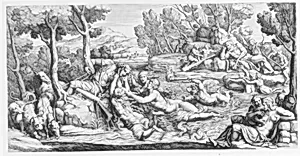
Hylas and the Water Nymphs
ca. 1635–1700
Medium
Engraving
Dimensions
Sheet: 10 5/8 × 21 1/8 in. (27 × 53.7 cm)
Classification
Prints
Department
Drawings and Prints
Museum
Metropolitan Museum of Art, New York, NY
Credit
Gift of Harry G. Friedman, 1964
Accession Number
64.682.125
Rights
Public Domain
Tags
Art Historical Context
This engraving captures the dramatic mythological encounter between Hylas, the youthful companion of Hercules, and a group of alluring water nymphs. As Hylas leans toward a pool to draw water, the nymphs emerge to claim him, their graceful forms creating a scene rich in tension and sensuality. The composition, originally designed by Giulio Romano—a leading Mannerist painter and Raphael’s gifted pupil—has been skillfully translated into print by Pietro Santi Bartoli in the seventeenth century. Executed as an engraving, the work demonstrates the medium’s remarkable capacity to convey intricate detail and tonal nuance through fine lines. Such prints played a vital role in circulating classical stories and Renaissance designs across Europe, allowing wider audiences to appreciate mythological narratives that might otherwise remain confined to palace walls or rare drawings. The inclusion of dogs and reclining female figures adds both narrative depth and visual interest, highlighting the engraving’s lively interplay between movement and stillness. Today, this sheet in the Metropolitan Museum’s collection preserves a vivid link between ancient myth, sixteenth-century invention, and Baroque reproductive artistry.
About the Artist
Pietro Santi Bartoli|Giulio Romano · 1615–1700
Pietro Santi Bartoli, born in Perugia in 1635, emerged as a pivotal figure in the Roman antiquarian revival of the late seventeenth century. Relocating to Rome as a youth, he initially pursued painting, studying under the French artist Jean Lemaire—known as "Le Petit Lemaire"—and later under the esteemed Nicolas Poussin, whose classical rigor profoundly shaped his early approach. Though traces of ...