
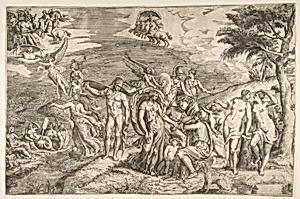
The Judgment of Paris
16th century
Medium
Etching
Dimensions
sheet: 11 15/16 x 18 5/16 in. (30.4 x 46.5 cm)
Classification
Prints
Department
Drawings and Prints
Museum
Metropolitan Museum of Art, New York, NY
Credit
The Elisha Whittelsey Collection, The Elisha Whittelsey Fund, 1949
Accession Number
49.97.269
Rights
Public Domain
Tags
Art Historical Context
Giulio Bonasone's *The Judgment of Paris*, a 16th-century etching, captures a timeless episode from classical mythology. In the tale, the Trojan prince Paris must decide which goddess—Hera,, or Aphrodite—is fairest, a choice that sparks the Trojan War. Bonasone's composition bursts with dynamic figures: nude men and women, along with horses, embodying the Renaissance fascination with ancient Greek and Roman stories. Produced on a grand sheet measuring nearly 12 by 18 inches, this print exemplifies the era's revival of pagan themes amid the Catholic Church's cultural influence. As an early master of etching, Bonasone helped elevate the medium beyond engraving's rigid lines. Etching allowed for softer, more fluid strokes, mimicking drawing's spontaneity and enabling intricate shading on metal plates bitten by acid. Active in Bologna and Rome, Bonasone often reproduced works by Raphael and others, blending Mannerist elegance with mythological drama. This piece highlights printmaking's role in democratizing art, making elite subjects accessible to collectors across Europe. Housed in the Metropolitan Museum of Art's Drawings and Prints department, thanks to The Elisha Whittelsey Collection (1949), *The Judgment of Paris* invites us to ponder beauty's perils—much like Paris himself. A stunning fusion of sensuality and storytelling.
About the Artist
Giulio Bonasone · 1500–1600
Comment on works: History; Mythology