
il serait si doux d'aimer
1923
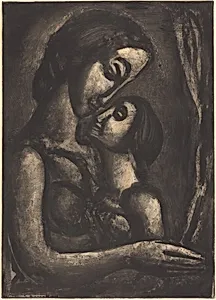
Medium
aquatint and drypoint over heliogravure
Classification
Portfolio
Department
CG-W
Museum
National Gallery of Art, Washington, D.C.
Credit
Rosenwald Collection
Accession Number
1950.1.154
Rights
Public Domain
Art Historical Context
Georges Rouault's *il serait si doux daimer* (1923)—translating to "it would be so sweet to love"— a evocative print housed in the National Gallery of's Rosenwald Collection, of the museum's esteemed Department of Modern Prints and Drawings (CG-W). Created as an element within a portfolio classification, this work exemplifies Rouault's mastery of intaglio printmaking during the interwar period, a time when he transitioned from painting to deeply personal graphic series exploring human emotion and spirituality. The medium—aquatint and drypoint over heliogravure—blends photomechanical precision with handmade artistry. Heliogravure provides a tonal foundation akin to photography, while aquatint adds textured, painterly depths resembling watercolor washes, and drypoint delivers Rouault's signature burr-rich lines, evoking the bold contours of stained-glass windows that influenced his Expressionist style. Associated with Fauvism early on but distinctly his own, Rouault's technique here infuses melancholy romance into stark forms, contrasting his frequent themes of suffering and faith. This piece highlights Rouault's innovative print portfolios, which brought his vivid, moralistic vision to wider audiences amid post-World War I introspection. Visitors will appreciate its intimate scale and emotional resonance, a testament to the Rosenwald Collection's focus on transformative 20th-century graphics.
About the Artist
Georges Rouault · 1871–1958
Georges-Henri Rouault was born on May 27, 1871, in a Paris cellar during the violent "Bloody Week" of the Paris Commune, when a stray shell destroyed his family's home in the working-class Belleville district. Raised by a carpenter father who worked at the Pleyel piano factory and a grandfather who collected prints by Honoré Daumier, Rembrandt, Courbet, and Manet, Rouault showed early artistic pro...