
Ile de Fîleh (Philæ), Édifice de l'Est - Façade Occidentale - Vue du Point E
1851–52, printed 1853–54
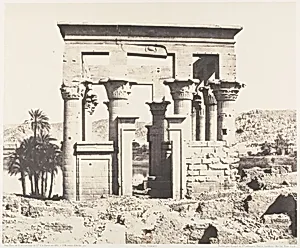
Medium
Salted paper print from paper negative
Dimensions
25.1 x 30.5 cm. (9 7/8 x 12 in.)
Classification
Photographs
Department
Photographs
Museum
Metropolitan Museum of Art, New York, NY
Credit
Purchase, Lila Acheson Wallace Gift, 1976
Accession Number
1976.607.88
Rights
Public Domain
Tags
Art Historical Context
Step into the sun-drenched ruins of Phil Island on the Nile with Félix Teynard's *Ile de Fîleh (Philæ), Éd de l'Est - Façade Occidentale - Vue Point E* (1851–52, printed 1853–54). This salted paper print from a paper negative captures the intricate western facade of the East Building amid ancient Egyptian temple remnants, viewed from a precise vantage point labeled "E." Teynard, a pioneering French photographer, documented Egypt's monumental architecture during a time of fervent European fascination with antiquity, contributing to albums like *Voyage en Égypte et Nubie*. Printed by Imprimerie Photographique de H. de Fonteny et Cie, this 25.1 x 30.5 cm photograph exemplifies early calotype techniques—William Henry Fox Talbot's paper negative process—which allowed for textured, atmospheric images unlike the sharp clarity of later methods. The soft tonalities and subtle details evoke the mystery of these sacred sites, once dedicated to Isis and now poignant symbols of lost grandeur. Acquired by The Metropolitan Museum of Art through the Lila Acheson Wallace Gift in 1976, this work highlights photography's role in 19th-century archaeology, preserving fragile ruins for posterity before modern threats like the Aswan Dam. A window into imperial exploration and artistic innovation, it invites us to ponder the enduring allure of ancient wonders.
About the Artist
Félix Teynard|Imprimerie Photographique de H. de Fonteny et Cie · 1817–1892
**Félix Teynard (1817–1892)** was a pioneering French photographer whose work captured the ancient wonders of Egypt and Nubia with unprecedented precision and artistry. Born on January 14, 1817, in Saint-Flour, he trained as a civil engineer in Grenoble, a hub of Egyptology that likely sparked his fascination with ancient architecture. Little is documented about his early life or formal photograph...