
Illuminated Jewish Marriage Contract Fragment in Aramaic
18th century
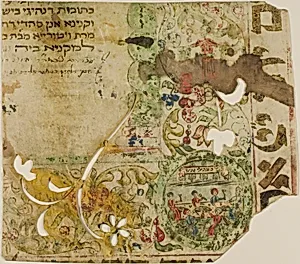
Medium
Manuscript cutting in tempera and colored inks, with floral cutouts, and Hebraic inscriptions in brown and black inks, on vellum
Dimensions
17.6 × 19.9 cm (6 15/16 × 7 7/8 in.)
Classification
tempera
Department
Prints and Drawings
Museum
Art Institute of Chicago
Accession Number
107339
Rights
Public Domain
Art Historical Context
This delicate fragment from an 18th-century illuminated Jewish marriage contract, known as a *ketubah*, offers a glimpse into the artistry and rituals of Jewish life. Written in Aramaic, the traditional language of such documents, it outlines the groom's obligations to his bride, blending legal text with vibrant decoration. Crafted on vellum—a fine parchment made from animal skin—this 17.6 × 19.9 cm piece survives as a "manuscript cutting," likely trimmed from a larger document for preservation or display. The artwork showcases exquisite techniques typical of Jewish illuminated manuscripts: tempera paints and colored inks create vivid hues, while intricate floral cutouts add a lace-like elegance. Hebraic inscriptions in brown and black inks frame the composition, evoking the ornate style of Sephardic or Ottoman ketubot from the period. These decorations, often symbolizing fertility and joy, transformed solemn contracts into cherished family heirlooms. Housed in the Art Institute of Chicago's Prints and Drawings Department, this fragment highlights the cultural significance of ketubot as both legal safeguards for women and expressions of communal artistry. In an era before printed forms, such handmade treasures preserved traditions amid diaspora, inviting us to appreciate the skill of anonymous scribes who illuminated life's milestones.
About the Artist
Unknown
The artist designated as "Unknown" in our virtual museum's collection exemplifies a poignant chapter in art history: creators whose identities have faded into obscurity despite the enduring power of their work. With only one known artwork attributed to them in our holdings, this figure represents countless anonymous hands that shaped visual culture across centuries. Museums worldwide, including th...