
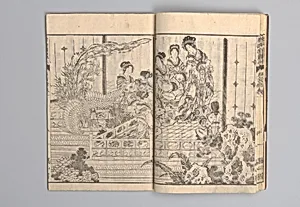
画本唐詩選五言律排律|Illustrated “Anthology of Tang-Dynasty Poems” in Five-Syllable Lines (Tōshisen ehon gogon ritsu hairitsu) 画本唐詩選五言律排律
1836 (Tenpō 7)
Medium
Format: 5 volumes, fukurotoji (pouch binding); chūbon
Dimensions
each: 9 × 6 3/16 in. (22.8 × 15.7 cm)
Classification
Illustrated Books
Culture & Period
Japan · Edo period (1615–1868)
Department
Asian Art
Museum
Metropolitan Museum of Art, New York, NY
Credit
Purchase, Mary and James G. Wallach Foundation Gift, 2013
Accession Number
2013.731a–e
Rights
Public Domain
Tags
Art Historical Context
Katsushika Hokus, the legendary Japanese artist renowned for his ukiyo-e woodblock prints like *The Great Wave offanagawa*, created this exquisite illustrated book in 1836 during the late Edo period. Titled *Illustrated “Anthology of Tang-Dynasty Poems” in Fiveyllable Lines (Tōshisen ehon g ritsu hairitsu)* it features selections of classical Chinese Tang poetry—specifically five-syllable regulated verses and long regulated verses—brought vividly to life through Hokusai's masterful illustrations. Produced as five volumes in the traditional fukurotoji pouch binding and chūbon (medium) format, each measuring about 9 × 6 inches, this work exemplifies the era's fusion of literature and visual art. Hokusai's images, depicting graceful women, mythical creatures, and lush plants, infuse the timeless elegance of Tang poetry with dynamic Japanese aesthetics. Ukiyo-e artists like Hokusai often drew from Chinese literary traditions, making such anthologies popular among Edo Japan's educated elite. The woodblock technique allowed for intricate details and vibrant colors, highlighting themes of nature, fantasy, and human emotion that resonated across cultures. Acquired by the Metropolitan Museum of Art in 2013, this rare book underscores Hokusai's versatility beyond famous landscapes, showcasing his skill in narrative illustration and the enduring cultural exchange between Japan and China during the Edo period (1615–1868). Visitors will appreciate how it captures poetry's spirit in delicate, imaginative scenes.
About the Artist
Katsushika Hokusai 葛飾北斎 (Japanese) · 1760 –1849
Japanese, Tokyo (Edo) 1760–1849 Tokyo (Edo)