
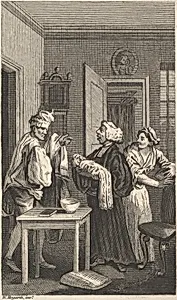
Illustration to "Tristram Shandy," Volume 4
19th century
Medium
Engraving
Dimensions
image: 5 1/4 x 3 1/8 in. (13.3 x 7.9 cm) sheet: 6 15/16 x 9 3/8 in. (17.7 x 23.8 cm)
Classification
Prints
Department
Drawings and Prints
Museum
Metropolitan Museum of Art, New York, NY
Credit
Gift of Sarah Lazarus, 1891
Accession Number
91.1.22b
Rights
Public Domain
Tags
Art Historical Context
This enchanting engraving, titled *Illustration to "Tristram Sh," Volume 4*, a pivotal moment from Laurence Sterne's wildly innovative 18th-century *The Life and Opinions ofistram Shandy,*. Credited to William Hogarth the master of satirical prints, alongside Sterne, it likely depicts a humorous domestic scene featuring men, women, an infant, and a tablehallmarks of the book's eccentric narrative style, blending philosophy, comedy, and chaos. Hogarth's sharp wit shines through, poking fun at human folly in the spirit of Sterne's digressive storytelling. As a 19th-century engraving, this print exemplifies the medium's power for book illustration, where intricate lines etched into metal plates allowed for detailed, reproducible images that brought literature to life for wider audiences. Hogarth's rococo-influenced style, with its lively figures and exaggerated expressions, made such works accessible yet profound, bridging art and text during the Enlightenment era. Housed in the Metropolitan Museum of Art's Drawings and Prints department, this piece highlights the cultural fusion of visual satire and experimental prose, inviting visitors to ponder Sterne's absurdities—like the novel's infamous interrupted birth scene—through Hogarth's masterful gaze. A delightful window into 18th-century literary mischief!
About the Artist
William Hogarth|Laurence Sterne · 1697–1764
William Hogarth (1697-1764) was an English painter, printmaker, and pictorial satirist who became the first great English-born artist to attract admiration abroad. Born into poverty in London, the son of a failed schoolmaster who was imprisoned for debt, Hogarth's early experiences with the harsh realities of 18th-century urban life profoundly shaped his artistic vision. After apprenticing with si...