
Images (Les images)
1889
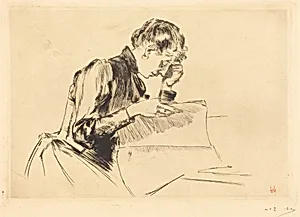
Medium
drypoint
Classification
Department
CG-E
Museum
National Gallery of Art, Washington, D.C.
Credit
Rosenwald Collection
Accession Number
1943.3.5596
Rights
Public Domain
Art Historical Context
Auguste Lepère's *Images (Les images)*, created in 1889, is a captivating drypoint print that exemplifies the artist's mastery of intimate urban scenes from late 19th-century Paris. As a prominent French printmaker and illustrator, Lepère captured the bustling energy of everyday life during the Belle Époque, period marked by cultural vibrancy and the 1889 Exposition Universelle Housed in the National Gallery of Art's Rosen Collection (Department CG-E), this work reflects his dedication to documenting the city's street vendors, markets, and fleeting moments with remarkable sensitivity. Drypoint, Lepère's chosen medium here, involves scratching directly into a copper plate with a sharp needle, raising a soft burr that produces rich, velvety lines and tonal depth in the print. Unlike smoother etching techniques, drypoint yields an expressive, painterly quality—ideal for Lepère's textured depictions of light, shadow, and human activity. Editions were often limited, enhancing the print's rarity and appeal to collectors. This piece holds artistic significance as part of Lepère's oeuvre, bridging Realism and emerging Art Nouveau influences through its detailed observation and decorative flair. Visitors to the National Gallery will appreciate how *Images* invites a closer look at history's vivid snapshots, preserved for generations.
About the Artist
Auguste Lepère · 1849–1918
Auguste-Louis Lepère (1849–1918), son of the sculptor François Lepère, was born in Paris on November 30, 1849, into an artistic family that shaped his early path. At age thirteen, he apprenticed in the Paris studio of the English wood engraver Joseph Burn Smeeton, honing his skills in wood engraving until 1867. He furthered his training with drawing classes under Horace Lecoq de Boisbaudran at the...