
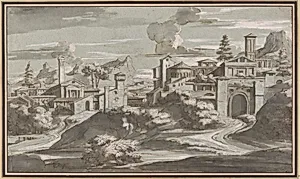
Imaginary Classical Landscape
c. 1700
Medium
pen and brown ink with brown wash and white gouache on blue laid paper, laid down on an old mount
Dimensions
sheet: 23.6 × 40.7 cm (9 5/16 × 16 in.) mount: 33.4 × 50 cm (13 1/8 × 19 11/16 in.)
Classification
Drawing
Department
CG-E
Museum
National Gallery of Art, Washington, D.C.
Credit
Purchased as the Gift of Dian Woodner
Accession Number
2017.85.1
Rights
Public Domain
Art Historical Context
Louis Chéron’s *Imaginary Classical Landscape* (c. 1700) exemplifies the enduring appeal of idealized antique scenery in early eighteenth-century European art. Working in a period when French artists looked to the Roman Campagna and the works of Claude Lorrain and Nicolas Poussin for inspiration, Chéron invented a serene vista of ruined temples, distant hills, and tranquil water. The drawing’s modest size belies its atmospheric depth, achieved through delicate pen lines and layered brown washes that suggest both sunlight and shadow. The medium—pen and brown ink with brown wash and white gouache on blue laid paper—is particularly effective here. Blue paper, favored by Baroque draftsmen, provided a ready mid-tone against which the artist could build luminous highlights with opaque white and rich, velvety shadows with ink. The result is a luminous, almost painterly surface that invites viewers to step into an imagined world of classical harmony. Acquired by the National Gallery of Art as the gift of Dian Woodner, this sheet offers visitors a glimpse into the refined draftsmanship and poetic imagination that shaped landscape traditions long before photography.