
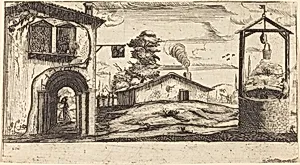
Landscape with a Well
17th century or later
Medium
etching on laid paper
Dimensions
sheet (trimmed to plate mark): 6.2 × 11.1 cm (2 7/16 × 4 3/8 in.)
Classification
Department
CG-E
Museum
National Gallery of Art, Washington, D.C.
Credit
R.L. Baumfeld Collection
Accession Number
1969.15.174
Rights
Public Domain
Art Historical Context
**Landscape with a Well** This intimate etching, *Landscape with a Well*, inspiration from the masterful works of Jacques Callot, a pioneering 17th-century Frenchmaker renowned for his intricate landscapes and genre scenes. Created in the 17th century later as a work "after" Callot, it reflects his influence during an era when printmaking flourished across Europe, allowing artists to capture pastoral scenes with remarkable precision. Callot's style, characterized by delicate lines and atmospheric depth, made his etchings highly sought after by collectors, bridging art and emerging mass reproduction. Etched on laid paper—a traditional support with visible chain lines that speaks to early modern papermaking techniques—the print measures just 6.2 × 11.1 cm, inviting close inspection of its fine details. Etching, Callot's preferred method, involved coating a copper plate with acid-resistant ground, incising lines, and immersing it in acid to "bite" the grooves, yielding rich tonal variations ideal for evoking rugged terrain and serene waterside motifs like the central well. Housed in the National Gallery of Art's R.L. Baumfeld Collection (Department CG-E), this small-scale print exemplifies the enduring appeal of 17th-century landscape art, blending technical innovation with poetic observation of the natural world. Visitors are encouraged to lean in and trace the etched paths, connecting with a time when such images brought distant vistas into private hands.
About the Artist
after Jacques Callot
**Jacques Callot (c. 1592–1635)**, the master whose designs inspired the works attributed "after Jacques Callot," was a pioneering French Baroque printmaker and draftsman born in Nancy, capital of the independent Duchy of Lorraine (now northeastern France). From a noble family—his father served as master of ceremonies and herald-at-arms to the Duke of Lorraine—young Callot was apprenticed to a gol...