
Imaginary Landscape
1543
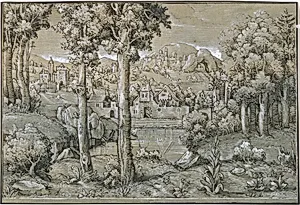
Medium
Pen and dark brown ink and brush and grayish blue watercolor, washed in blue, heightened with brush and opaque white, on greenish blue prepared paper.
Dimensions
5 11/16 x 8 3/8 in. (14.4 x 21.3 cm)
Classification
Drawings
Department
Robert Lehman Collection
Museum
Metropolitan Museum of Art, New York, NY
Credit
Robert Lehman Collection, 1975
Accession Number
1975.1.864
Rights
Public Domain
Tags
Art Historical Context
**Imaginary Landscape** by Hanns Lautensack, created in 1543, visitors into a fantastical world of towering ruins, winding paths, and ethereal vistas, all captured on a modest sheet of greenish blue prepared paper (5 11/16 x 8 3/8 in.). This from the Robert Lehman Collection The Metropolitan Museum of Art exemplifies Nuremberg artist's skill in blending observation with invention, a hallmark of 16th-century German draftsmen influenced by the Renaissance spirit. Lautensack, active in the vibrant artistic hub of Nuremberg, crafted imaginary landscapes that echoed the era's fascination with antiquity and nature's grandeur. Works like this one prefigure the rise of pure landscape art, moving beyond mere background scenery to standalone compositions rich in mood and spatial illusion. The piece reflects the Northern Renaissance's emphasis on detailed naturalism amid Reformation-era introspection. Executed in pen and dark brown ink with brush and grayish blue watercolor washes, then heightened with opaque white, the medium creates dramatic depth and luminous highlights against the tinted paper. This sophisticated layering technique—uncommon for its time—enhances atmospheric perspective, making distant forms recede into misty blues, drawing the eye through an otherworldly scene that feels alive with possibility. A gem for lovers of early modern drafts!
About the Artist
Hanns Lautensack · 1515–1566
Hanns Lautensack, born in 1524 in Bamberg, Germany, was the son of Paul Lautensack, a noted painter and organist. Alongside his brother Heinrich, a goldsmith, the family relocated to Nuremberg in 1527, where Hanns immersed himself in the vibrant artistic milieu of the city. There, he likely apprenticed with a goldsmith, honing skills in fine metalwork that informed his precise etching technique, t...