
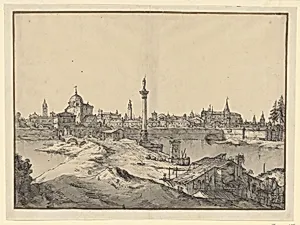
Imaginary View of Padua
ca. 1740–41
Medium
Pen and black ink, gray wash
Dimensions
12 9/16 x 16 3/4 in. (31.9 x 42.6 cm)
Classification
Drawings
Department
Robert Lehman Collection
Museum
Metropolitan Museum of Art, New York, NY
Credit
Robert Lehman Collection, 1975
Accession Number
1975.1.299
Rights
Public Domain
Tags
Art Historical Context
Bernardo Bellotto's *Imaginary View of Padua* (ca. 1740–41) invites viewers into a dreamlike rendition of the Italian city, blending architectural grandeur with artistic fancy. Crafted when Bellotto was in his early twenties, this drawing exemplifies the Venetian *vedutismo* tradition—topographical views popularized by his uncle, Canaletto. Though "imaginary," it draws from real urban landmarks, reimagining Padua's historic buildings, towers, and piazzas in a harmonious, atmospheric composition that feels both familiar and fantastical. Executed in pen and black ink with gray wash on paper (12 9/16 x 16 3/4 in.), the work highlights Bellotto's virtuoso technique. Fine ink lines delineate precise architectural details, while subtle gray washes build depth, shadow, and a sense of luminosity, mimicking the effects of oil paintings. This medium was ideal for preparatory sketches or standalone *capricci* (whimsical scenes), allowing 18th-century artists to experiment freely before grand canvases. Housed in the Robert Lehman Collection at The Metropolitan Museum of Art, this drawing captures the cultural allure of Italy's Renaissance cities during the Grand Tour era, when Northern European travelers sought such evocative vistas. Bellotto's early mastery foreshadowed his later fame painting real views of Dresden, Vienna, and Warsaw, making this a gem for lovers of urban fantasy and draftsmanship.
About the Artist
Bernardo Bellotto · 1722–1780
Bernardo Bellotto (1722–1780) was an Italian painter of exceptional gifts who carried the art of the veduta — the precisely observed topographical view — from Venice across the courts of northern Europe, leaving behind some of the most detailed and haunting urban panoramas in the history of Western painting. Born in Venice, he was the nephew and pupil of the great vedutista Giovanni Antonio Canal,...