
Impasse Briare (de la Cité Coquenard)
1860s
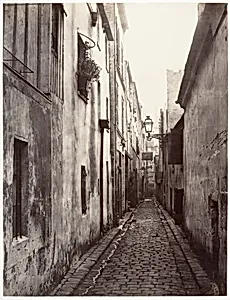
Medium
Albumen silver print from glass negative
Dimensions
Image: 62.9 x 45.2 cm (24 3/4 x 17 13/16 in.) Mount: 24 13/16 × 17 11/16 in. (63 × 45 cm)
Classification
Photographs
Department
Photographs
Museum
Metropolitan Museum of Art, New York, NY
Credit
Gilman Collection, Purchase, Mr. and Mrs. Henry R. Kravis Gift, 2005
Accession Number
2005.100.362
Rights
Public Domain
Tags
Art Historical Context
**Impasse Briare (de Cité Coquenard)** captured by Charles Marville in 1860s, offers a poignant glimpse into old Paris on the eve of transformation. Marville, the city's official photographer under Napoleon III, meticulously documented its narrow alleys and working-class neighborhoods like this dead-end passage in the Cité Coquenard. salt-print albumen silver images from glass negatives preserve the gritty charm of medieval streetscapes, soon to vanish under Baron Haussmann's sweeping urban renewal. Printed in rich sepia tones on a grand 62.9 x 45.2 cm scale, the albumen process—pioneered in the 1840s—lent exceptional clarity and depth, rivaling paintings in detail. Marville's straightforward, documentary style elevated photography as an artistic medium, influencing urban planning and preservation efforts. Today, housed in The Metropolitan Museum of Art's Gilman Collection, this work evokes the human scale of pre-modern Paris, where laundry lines and shadowed facades whispered stories of daily life amid inevitable change.
About the Artist
Charles Marville · 1813–1879
**Charles Marville**, born Charles François Bossu on July 17, 1813, in Paris, adopted his professional pseudonym around 1832 to avoid the stigma of "bossu," meaning hunchback in French. Trained as a painter, engraver, and illustrator, he spent nearly two decades producing woodblock illustrations for books and magazines before embracing photography around 1850. His transition coincided with the med...