
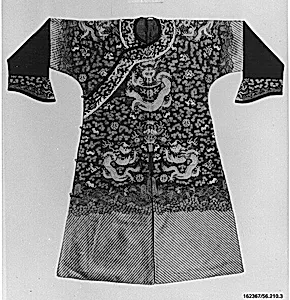
Imperial Robe
Unknown Artist
late 19th century
Medium
Silk
Dimensions
56 1/2 x 78 1/2 in. (143.51 x 199.39 cm)
Classification
Costumes-Embroidered
Culture & Period
China · Qing dynasty (1644–1911)
Department
Asian Art
Museum
Metropolitan Museum of Art, New York, NY
Credit
Bequest of Mrs. James W. Gerard, 1956
Accession Number
56.210.3
Rights
Public Domain
Tags
Art Historical Context
This magnificent Imperial Robe, crafted from luxurious silk in late 19-century China during the Qing (1644–1911), exemplifies the opulence of the empire's final imperial era. Measuring an impressive 56½ x 78½ inches, it was designed for high-ranking court officials or possibly the emperor himself, its embroidered surface alive with dynamic dragon motifs—a symbol of supreme power, divinity, and imperial authority in Chinese culture. Qing court, ruled by Manchu emperors, favored such robes for ceremonial wear, blending Manchu and Han Chinese influences in their sweeping, dragon-emblazoned designs. The robe's embroidery techniques highlight the pinnacle of Qing textile artistry, where skilled artisans used fine silk threads in intricate couching and satin stitches to create shimmering, three-dimensional dragons that seem to coil and soar. These front-facing imperial dragons, often reserved exclusively for the emperor, underscored the wearer's divine mandate to rule. As a bequest to the Metropolitan Museum of Art in 1956, this garment offers a tangible glimpse into the lavish rituals and hierarchical splendor of China's last dynasty, just before its dramatic fall in 1911. (198 words)