
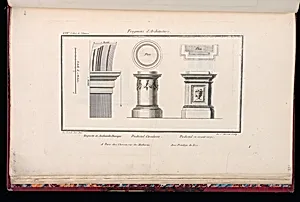
Imposte et Archivolte Dorique. Piedestal Circulaire. Piedestal en avant corps.
Medium
Classification
Department
Smithsonian Collection
Museum
Smithsonian American Art Museum
Credit
Purchased for the Museum by the Advisory Council
Accession Number
1921-6-330-128
Rights
Public Domain
About this artwork
Research in Progress
Art Historical Context
"Imposte et Archivolte Dorique Piedestal Circulaire.estal en avant corps" is a delicate architectural print by French artist Richard de Lalonde, created between 1775 and1788. Active during the late 18th century, Lalonde specialized in ornamental designs that captured the elegance of classical motifs. This work, housed in the Smithsonian Art Museum's Smithsonian Collection showcases precise renderings of Doric-style imposts, archivolts, and circular and projecting pedestals—elements essential to neoclassical architecture inspired by ancient Greece and Rome. As a print, the piece reflects the era's booming market for engraved designs, which allowed architects, designers, and builders across Europe to share and replicate sophisticated details. Produced during the transition from Louis XV's rococo to Louis XVI's restrained neoclassicism, it embodies the Enlightenment's fascination with proportion, symmetry, and antiquity. These motifs would have influenced grand public buildings, furniture, and interiors, bridging artistic theory with practical application. Acquired through the Museum's Advisory Council purchase, this print offers a window into 18th-century French design innovation. Though research continues, it invites visitors to appreciate how such technical illustrations fueled the neoclassical revival, shaping tastes that echoed in early American architecture. (198 words)