
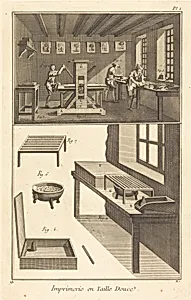
Imprimerie en Taille Douce: pl. I
Medium
engraving on laid paper
Dimensions
plate: 35.4 x 22.3 cm (13 15/16 x 8 3/4 in.) sheet: 44.5 x 29.5 cm (17 1/2 x 11 5/8 in.)
Classification
Department
CG-E
Museum
National Gallery of Art, Washington, D.C.
Credit
Ailsa Mellon Bruce Fund
Accession Number
1996.20.13
Rights
Public Domain
Art Historical Context
"Imprimerie en T Douce: pl. I" is a captivating 18th-century French engraving that delves into the intricate world of intaglio printing, technique known as *taille douce* (meaning "soft cutting"). Created between 1771 and 1779 by an anonymous French artist after designs by Robert Benard and-Jacques Goussier—inent illustrators for Denis Diderot's groundbreaking *Encyclopédie*—this plate likely illustrates the tools, presses, or processes central to producing finely detailed prints. Measuring 35.4 x 22.3 cm on laid paper, it exemplifies the precision of engraving, where lines are incised into a metal plate and inked to transfer intricate images onto paper. Engraving on laid paper, with its characteristic chain lines visible under light, was a hallmark of high-quality 18th-century printmaking, allowing for widespread dissemination of knowledge during the Enlightenment. This work's inclusion in the National Gallery of Art's collection (acquired through the Ailsa Mellon Bruce Fund) underscores its role in documenting artisanal techniques amid France's intellectual revolution. Benard and Goussier's collaboration reflects the *Encyclopédie's* mission to visualize sciences and crafts, making complex machinery accessible. For visitors, this print offers a window into how Enlightenment thinkers celebrated technical innovation, bridging art and industry in a single, elegant image. A testament to print's power as both art and education, it invites us to appreciate the meticulous craft behind the page.