
Improvisation No. 30 (Cannons)
1913
Medium
Oil on canvas
Dimensions
111 × 111.3 cm (43 11/16 × 43 13/16 in.)
Classification
oil on canvas
Department
Modern Art
Museum
Art Institute of Chicago
Accession Number
8991
Rights
Public Domain
About this artwork
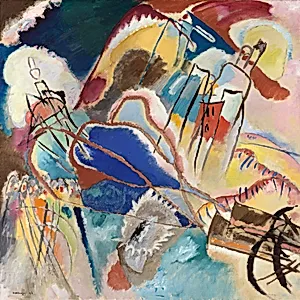
In his 1912 book Concerning the Spiritual in Art, Vasily Kandinsky made an analogy between music and painting as two means of abstraction, a radical mode of artmaking that freed color and line from their traditionally representational functions. Between 1910 and 1914 he produced “improvisations,” works he described as unconscious, spontaneous expressions. Kandinsky commented on Improvisation No. 30 (Cannons) in a letter to Arthur Jerome Eddy, a friend and collector from Chicago: “The cannons . ....
Art Historical Context
Vasily Kandinsky’s *Improvisation No. 30 (Cannons)* captures a pivotal moment in the birth of abstract art. Painted in 1913 while the Russian-born artist was living in Munich, the nearly square canvas belongs to his celebrated “Improvisation” series, in which he sought to translate musical experience directly into color and form. Rejecting recognizable subject matter, Kandinsky used swirling lines, vibrant bursts of red, blue, and yellow, and dynamic brushwork to evoke emotion without literal representation. The painting’s subtitle, “Cannons,” hints at the few semi-recognizable shapes that emerge from the abstraction—dark, tubular forms that suggest artillery. Created on the eve of World War I, these forms give the work an undercurrent of tension and impending conflict, even as the overall composition pulses with energy and freedom. Kandinsky believed that color and line could resonate like musical notes, and this oil on canvas demonstrates his pioneering effort to free painting from narrative duties. Today in the Art Institute of Chicago’s modern collection, the work remains a landmark example of how artists in the early twentieth century began to explore pure visual language, influencing generations of abstract painters who followed.
About the Artist
Vasily Kandinsky
**Wassily Kandinsky (1866–1944)** was a Russian painter and art theorist widely recognized as one of the pioneers of abstract art in Western painting. Born in Moscow on December 16, 1866, to a tea merchant father and a mother from a noble family with Tatar roots, he initially pursued studies in law and economics before turning to art at age 30. In 1896 he settled in Munich, where he trained first ...