
In an Elevator
1916
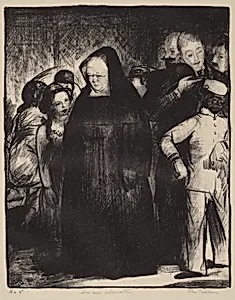
Medium
lithograph in black on wove paper
Dimensions
image: 25.6 x 20.3 cm (10 1/16 x 8 in.) sheet: 41.3 x 29.9 cm (16 1/4 x 11 3/4 in.)
Classification
Department
CG-W
Museum
National Gallery of Art, Washington, D.C.
Credit
Gift of Mrs. Jane C. Carey in memory of her mother, Mrs. Addie Burr Clark
Accession Number
1951.13.1
Rights
Public Domain
Art Historical Context
George Bellows created this lithograph in 1916, capturing a fleeting moment of everyday urban life during a period of rapid modernization in American cities. The title suggests an intimate glimpse inside an elevator, a relatively new invention that symbolized the vertical growth of skyscrapers and the bustling pace of metropolitan existence. Bellows, associated with the Ashcan School’s focus on realistic depictions of contemporary society, often turned his attention to such ordinary scenes, highlighting the human interactions and rhythms of modern city living. Printed in black on wove paper, the lithograph demonstrates the medium’s ability to convey bold contrasts and fluid lines with remarkable clarity. Lithography allowed artists like Bellows to produce affordable multiples, making art more accessible beyond elite galleries. The compact image size invites close viewing, emphasizing subtle gestures and expressions among the figures. This work reflects the early twentieth-century fascination with technology and social spaces, offering viewers a timeless window into how people navigated the new realities of crowded urban environments.
About the Artist
George Bellows · 1882–1925
George Wesley Bellows was born on August 12, 1882, in Columbus, Ohio, the only child of building contractor George Bellows Sr. and Anna Smith Bellows, with an older half-sister, Laura. A talented athlete who excelled in baseball and basketball at Ohio State University from 1901 to 1904, Bellows illustrated for the school yearbook before rejecting a professional baseball contract to pursue art. In ...