
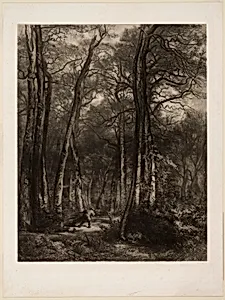
In the Forest
1851
Medium
Lithograph in black on chine, laid down on white wove paper
Dimensions
Image: 63 × 50.2 cm (24 13/16 × 19 13/16 in.); Sheet: 78 × 58.5 cm (30 3/4 × 23 1/16 in.)
Classification
lithograph
Department
Prints and Drawings
Museum
Art Institute of Chicago
Accession Number
72700
Rights
Public Domain
About this artwork
Karl Bodmer, who worked with Millet at Barbizon, asked Millet to collaborate on this work by drawing the figure. Millet's direct contribution to this Lithograph is therefore minimal, but his influence remains evident in Bodmer's handling of landscape.
Art Historical Context
Karl Bodmer’s 1851 lithograph *In the Forest* captures the quiet grandeur of a wooded landscape through meticulous draftsmanship. A Swiss-born artist who gained renown for his earlier travels documenting the American West, Bodmer here turns his attention to European nature, presenting a dense canopy of trees that invites viewers to pause and observe the play of light and shadow. Created during the height of the Romantic era, the print reflects the period’s growing fascination with untamed nature as a source of spiritual renewal. Printed in black on chine collé—a delicate paper layer adhered to a sturdier support—the work demonstrates lithography’s remarkable ability to convey fine tonal gradations and intricate textures. This reproductive medium allowed artists to share detailed images with a broader public at a time when original paintings remained largely accessible only to private collectors. Measuring over two feet in height, the sheet’s generous scale further enhances the immersive quality of the forest interior. Today housed in the Art Institute of Chicago’s Department of Prints and Drawings, *In the Forest* exemplifies how nineteenth-century printmaking bridged fine art and popular appreciation of the natural world.
About the Artist
Karl Bodmer · 1809–1893
Johann Carl Bodmer was born on February 11, 1809, in Zürich, Switzerland, and received his training as a painter and engraver under his uncle Johann Jakob Meier, who had himself studied under the prominent engraver Heinrich Füssli. By the late 1820s Bodmer had relocated to Koblenz, Germany, where his work came to the attention of Prince Maximilian zu Wied-Neuwied, a German naturalist-explorer plan...