
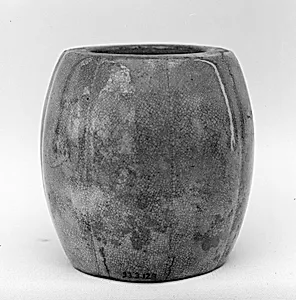
Incense Burner
Unknown Artist
1620
Medium
Clay with finely crackled glaze (Satsuma ware)
Dimensions
H. 3 in. (7.6 cm)
Classification
Ceramics
Culture & Period
Japan · Edo period (1615–1868)
Department
Asian Art
Museum
Metropolitan Museum of Art, New York, NY
Credit
Gift of Charles Stewart Smith, 1893
Accession Number
93.3.128
Rights
Public Domain
Art Historical Context
This delicate incense burner, crafted around 1620 during Japan's Edo period (1615–8), exemplifies the refined artistry of Satsuma from the southern island of Kyushu. Standing just 3 inches (7.6 cm) tall, this small ceramic vessel was designed for burning fragrant incense, a cherished practice in tea ceremonies, Buddhist rituals, and daily life among the growing merchant class. The Edo era marked a time of peace and cultural flourishing under the Tokugawa shunate, when such intimate objects reflected Japan's appreciation for subtle beauty and sensory harmony. Satsuma ware is renowned for its clay body coated in a finely crackled glaze—a distinctive technique achieved through precise kiln firing, where controlled cooling creates the intricate web of cracks. This "crazing" not only enhances the piece's tactile appeal but also highlights the potter's skill in balancing clay composition and temperature, a hallmark of early Japanese ceramics. Though the artist remains unknown, the burner's modest scale and elegant simplicity embody wabi-sabi aesthetics: the beauty found in imperfection and transience. Today, this treasure resides in the Metropolitan Museum of Art's Asian Art Department, a gift from Charles Stewart Smith in 1893. It invites visitors to ponder the quiet rituals of Edo Japan, where scent bridged the spiritual and everyday worlds.