
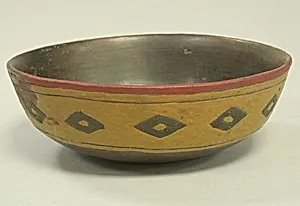
Incised Painted Bowl
Unknown Artist
7th–5th century BCE
Medium
Ceramic, pigment
Dimensions
H. 2 × Diam. 5 3/4 in. (5.1 × 14.6 cm)
Classification
Ceramics-Containers
Culture
Paracas
Department
Arts of Africa, Oceania, and the Americas
Museum
Metropolitan Museum of Art, New York, NY
Credit
Gift of Mr. and Mrs. Nathan Cummings, 1964
Accession Number
64.228.100
Rights
Public Domain
Art Historical Context
This delicate *Incised Painted Bowl* from the Paracas culture of ancient Peru dates to the 7th–5th century BCE, formative period in South American prehistory. Crafted from ceramic and adorned with pigment, it measures just 2 inches high and 5¾ inches in diameter—perfectly sized for handheld use, perhaps in daily rituals or communal feasting. Housed in the Metropolitan Museum of Art's Department of Arts of Africa,, and the Americas, was generously gifted by Mr. and Mrs. Nathan Cummings in 1964. Paracas artisans excelled in ceramics, employing incising techniques to carve intricate patterns into the unfired clay, creating textured designs that were then highlighted with vibrant pigments. This dual method—combining relief carving with painting—not only enhanced visual depth but also showcased the culture's sophisticated craftsmanship, bridging functionality and artistry in everyday containers. As a rare survivor from Peru's south coast, where Paracas people are renowned for their textile mummy bundles and vivid iconography, this bowl offers a window into early Andean aesthetics. Its geometric motifs likely held symbolic meaning, reflecting a worldview intertwined with nature and cosmology, inviting us to ponder the hands that shaped it millennia ago.