
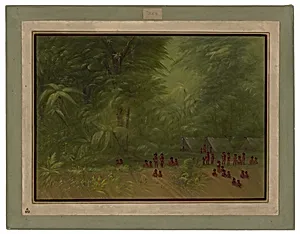
Indian Camp in the Forest
1854/1869
Medium
oil on card mounted on paperboard
Dimensions
overall: 47.5 x 62.8 cm (18 11/16 x 24 3/4 in.)
Classification
Painting
Department
CAB
Museum
National Gallery of Art, Washington, D.C.
Credit
Paul Mellon Collection
Accession Number
1965.16.289
Rights
Public Domain
Art Historical Context
George Catlin's *Indian Camp in the Forest* (1854/1869) captures a serene moment in Native American life, depicting a woodland encampment likely inspired by the artist's extensive travels among Indigenous peoples of the American West. Catlin, a pioneering 19th-century painter, dedicated much of his career to documenting tribes like the Sioux and Mandan before their cultures were profoundly altered by European-American expansion. This oil painting on card mounted on paperboard—measuring 18 11/16 x 24 3/4 inches—evokes the intimacy of a field study, rendered with Catlin's characteristic attention to ethnographic detail, from tipis nestled among trees to figures engaged in daily routines. As part of the Romantic tradition, Catlin's work blends realism with a sense of noble savagery, aiming to preserve vanishing ways of life for posterity. Painted later in his career, possibly from sketches made during his 1830s expeditions, it reflects his lifelong advocacy for Native rights amid U.S. policies of removal and assimilation. The modest medium of card support suggests it was a preparatory or portable piece, highlighting Catlin's innovative approach to on-site observation. Housed in the National Gallery of Art's Paul Mellon Collection, this painting invites visitors to reflect on America's Indigenous heritage, offering a poignant window into a pre-industrial frontier world.
About the Artist
George Catlin · 1796–1872
George Catlin (1796–1872), born in Wilkes-Barre, Pennsylvania, to Putnam Catlin and Polly Sutton—who had been captured by Native Americans during the 1778 Battle of Wyoming—initially pursued a legal career. Trained at Litchfield Law School, he was admitted to the bar in 1819 but abandoned law after two years to study art in Philadelphia in 1823. Self-taught as a portraitist, Catlin quickly gained ...