
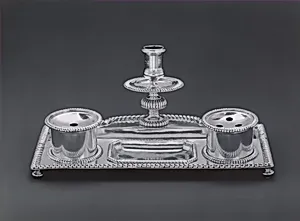
Inkstand
1690–91
Medium
Silver
Dimensions
Overall (Tray): 9 × 5 1/2 in. (22.9 × 14 cm); Height (with candlestick): 3 1/8 in. (7.9 cm)
Classification
Metalwork-Silver
Culture
British, London
Department
European Sculpture and Decorative Arts
Museum
Metropolitan Museum of Art, New York, NY
Credit
Bequest of Irwin Untermyer, 1973
Accession Number
1974.28.165a–f
Rights
Public Domain
Art Historical Context
Crafted in London between 1690 and 1691, this elegant inkstand by Peter Harache I exemplifies the refined silversmithing of late 17th-century Britain. Harache, a French Huguenot refugee who fled religious persecution and settled in England around 168, brought continental expertise to the London workshops. His work reflects the influx of skilled Protestant artisans after the Revocation of the Edict Nantes in 1685, elevating English silver to new heights of sophistication and contributing to the "Huguenot style"—characterized by crisp chasing, intricate engraving, and balanced proportions. Made entirely of silver, the inkstand features a rectangular tray measuring 9 × 5½ inches, with a candlestick rising to 3⅛ inches tall. Such desk accessories were essential for the literate elite, combining utility for writing inkwells, quills, and seals with luxurious display. The gleaming metal, likely marked with Harache's distinctive lion passant, showcased the era's advanced chasing and embossing techniques, turning everyday tools into status symbols. Housed in The Metropolitan Museum of Art's European Sculpture and Decorative Arts department through the bequest of Irwin Untermyer in 1973, this piece offers a glimpse into Restoration England's burgeoning luxury trade. It highlights how immigrant talent fueled artistic innovation, making silverware a canvas for personal prestige amid the opulence of William and Mary's court.