
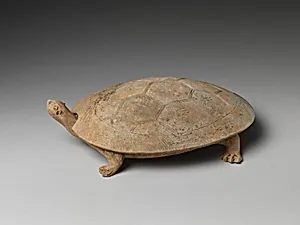
隋至唐初 陶龜硯|"Inkstone" and cover in the shape of a turtle
Unknown Artist
6th–7th century
Medium
Earthenware
Dimensions
H. 3 1/2 in. (8.9 cm); W. 9 1/4 in. (23.5 cm); L. 11 5/8 in. (29.5 cm)
Classification
Ceramics
Culture & Period
China · Sui (581–618)–Tang (618–907) dynasty
Department
Asian Art
Museum
Metropolitan Museum of Art, New York, NY
Credit
Purchase, The Vincent Astor Foundation Gift, 2003
Accession Number
2003.82a, b
Rights
Public Domain
Tags
Art Historical Context
This charming earthenware inkstone, shaped like a turtle with its fitted cover, hails from China's Sui (581–618) to early (618–907) dynasties in the 6th–7th century. Measuring about 11½ inches long, this functional yet whimsical object was designed for grinding ink sticks to create liquid ink for calligraphy and painting—essential tools for the literati class. Crafted from low-fired earthenware, a prevalent medium of the era, it reflects the period's ceramic innovations bridging the Sui's unification efforts and the Tang's golden age of artistic flourishing. Turtles held profound symbolism in Chinese culture, representing longevity, stability, and even cosmic support as one of the four mythical creatures guarding the cardinal directions. By molding the inkstone into this auspicious form, the unknown artisan transformed a scholarly necessity into a talismanic artwork, blending utility with spiritual resonance. Such pieces highlight how everyday objects in Tang-era China embodied philosophical ideals. Today, housed in the Metropolitan Museum of Art's Asian Art Department (purchase from The Vincent Astor Foundation Gift, 2003), this inkstone invites us to ponder the scholarly pursuits of ancient elites, where art and ritual intertwined seamlessly.