
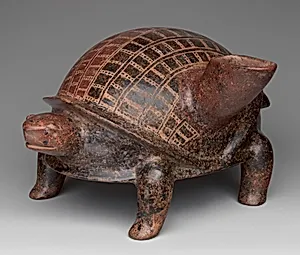
Turtle Vessel
200 BCE–300 CE
Medium
Ceramic
Dimensions
H. 7 1/4 × W. 11 × L. 13 1/2 in. (18.4 × 27.9 × 34.3 cm)
Classification
Ceramics-Containers
Culture
Colima
Department
Arts of Africa, Oceania, and the Americas
Museum
Metropolitan Museum of Art, New York, NY
Credit
Gift of Joanne P. Pearson, in memory of Andrall E. Pearson, 2007
Accession Number
2007.345.5
Rights
Public Domain
Tags
Art Historical Context
Behold the **Turtle Vessel**, a ceramic creation by Colima artists from West Mexico, dating to BCE–300 CE. 7¼ inches high, 11 inches wide, and13½ inches long, earthenware container takes the form of a turtle, blending functionality with whimsy. Colima potters, part of the pre-Columb shaft tomb tradition, were renowned for modeling everyday vessels into lively animal shapes, showcasing their skill in hand-building and firing clay to achieve durable, glossy surfaces. These zoomorphic ceramics hold deep cultural significance, reflecting the Colima people's close observation of nature and possible reverence for turtles as symbols of endurance or water deities in Mesoamerican lore. As a container, it likely served ritual or domestic purposes, evoking the region's vibrant artistic legacy during a time of complex burial practices and trade networks. Today, this treasure graces the Metropolitan Museum of Art's Arts of Africa, Oceania, and the Americas department, a generous gift honoring Joanne P. Pearson's memory of Andrall E. Pearson. It invites us to ponder ancient ingenuity—how a simple pot becomes a portal to Colima's world.