
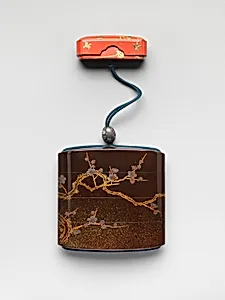
古満安匡作 梅鳥蒔絵印籠|Inrō with Bird on a Blossoming Plum Tree
19th century
Medium
Black lacquer and nashiji ground with gold and silver iroe togidashi maki-e Netsuke: box with plovers; red lacquer ground with gold and brown hiramaki-e Ojime: bead with flowers; shibuichi and enamel
Dimensions
3 1/16 x 3 1/8 x 13/16 in. (7.7 x 8 x 2.1 cm)
Classification
Inrō
Culture & Period
Japan · Edo period (1615–1868)
Department
Asian Art
Museum
Metropolitan Museum of Art, New York, NY
Credit
The Howard Mansfield Collection, Purchase, Rogers Fund, 1936
Accession Number
36.100.242
Rights
Public Domain
Tags
Art Historical Context
This exquisite inrō, created by the renowned lacquer artist Koma Yasutada in 19th-century Japan, exemplifies the refined artistry of the late Edo period. Inrō—small, portable cases worn suspended from the sash—served both practical and decorative purposes, often holding seals, medicines, or other personal items. Yasutada, a master of the Koma school, employed sophisticated maki-e techniques to depict a charming scene of a bird perched on a blossoming plum tree, symbolizing renewal and the beauty of nature. The piece features black lacquer with a shimmering nashiji (pear-skin) ground, enhanced by delicate layers of gold and silver powders in the togidashi maki-e method, which creates a smooth, polished surface. Accompanied by a matching netsuke and ojime, the ensemble highlights the harmonious coordination typical of high-quality Japanese accessories. Such works were treasured not only for their utility but also as expressions of personal taste and status among the merchant and samurai classes. Today, this elegant object in the Metropolitan Museum’s collection invites viewers to appreciate the meticulous craftsmanship and poetic imagery that defined Edo-period lacquer art.