
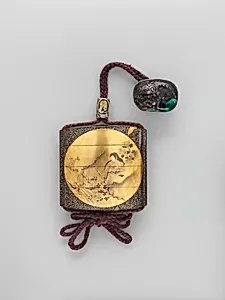
菊慈童蒔絵印籠|Inrō with “Chrysanthemum Youth” (Kikujidō)
Unknown Artist
first half of the19th century
Medium
Three cases; lacquered wood with togidashimaki-e imitating ink painting (togikirimaki-e) on gold and black lacquer ground Netsuke: purple and green ceramic shishi (Chinese lion) Ojime: inlaid metal with fruit basket
Dimensions
2 13/16 x 2 13/16 x 13/16 in. (7.1 x 7.1 x 2.1 cm)
Classification
Inrō
Culture & Period
Japan · Edo period (1615–1868)
Department
Asian Art
Museum
Metropolitan Museum of Art, New York, NY
Credit
Rogers Fund, 1913
Accession Number
13.67.49
Rights
Public Domain
Tags
Art Historical Context
This exquisite *Inrō with “Chrysanthemum” (Kikujidō)* is a masterful example of Edo-period (1615–1868) Japanese craftsmanship from the first half of the19th century. Inrō were compact, stackable lacquer boxes worn suspended from the sash by men to carry medicines, seals, or tobacco—elegant accessories blending functionality with artistry. This-case inrō, just 2 13/16 x 2 13/16 x 13/16 inches, human figures amid chrysanthemums, evoking themes of youth and seasonal beauty in Japanese culture. The artwork shines through its innovative lacquering: togidashimaki-e, a technique that polishes layered lacquer to reveal delicate ink-painting-like designs on a shimmering gold and black ground. Complementing it are a purple-and-green ceramic netsuke carved as a playful shishi (Chinese lion), a protective symbol warding off evil, and an ojime—a sliding bead—with inlaid metal depicting a fruit basket, symbolizing abundance. These elements highlight the inrō's role as a status symbol among samurai and merchants. Acquired through the Rogers Fund in 1913, this piece from the Metropolitan Museum of Art's Asian Art collection captures the Edo era's refined aesthetic, where everyday objects became canvases for subtle narrative and technical virtuosity. Visitors will appreciate how it bridges utility and artistry in Japan's lacquer legacy.