
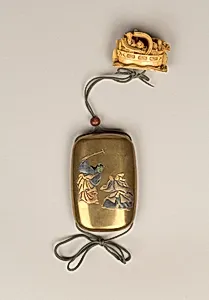
道成寺能蒔絵印籠|Inrō with the Noh Play Dōjōji (obverse) and Flowering Cherry Tree (reverse)
Unknown Artist
mid-19th century
Medium
Four cases; lacquered wood with gold, silver, color hiramaki-e, togidashimaki-e on gold ground Netsuke: treasure ship with seven gods of good fortune; ivory Ojime: wood bead
Dimensions
3 1/4 x 2 3/16 x 3/4 in. (8.3 x 5.6 x 1.9 cm)
Classification
Inrō
Culture & Period
Japan · Edo (1615–1868) or Meiji (1868–1912) period
Department
Asian Art
Museum
Metropolitan Museum of Art, New York, NY
Credit
H. O. Havemeyer Collection, Bequest of Mrs. H. O. Havemeyer, 1929
Accession Number
29.100.861
Rights
Public Domain
Tags
Art Historical Context
This exquisite *inrō*, a compact lacquered case from mid-19th-century Japan (do or early Meiji period), served as a fashionable accessory for carrying personal items like medicines or seals. Suspended from a kimono sash via a cord secured by an ivory netsuke and wooden ojime bead, it the refined craftsmanship of the era. The netsuke depicts a treasure ship brimming with the Seven Gods of Good Fortune—Ebisu, Daikoku, and others—symbolizing prosperity protection, a whimsical touch to an otherwise elegant ensemble. The obverse features scenes from the famed Noh play *Dōjōji*, depicting dramatic moments of dance and pursuit beneath a temple bell, while the reverse blooms with a flowering cherry tree, evoking Japan's cherished motif of fleeting beauty (*mono no aware*). Crafted from lacquered wood on a shimmering gold ground, the decoration employs sophisticated *maki-e* techniques: *hiramaki-e* for flat, sprinkled gold and silver designs, and *togidashimaki-e* for burnished highlights that reveal underlying layers through polishing. These methods, perfected over centuries, highlight lacquerware's status as a pinnacle of Japanese decorative arts. Housed in The Metropolitan Museum of Art's H. O. Havemeyer Collection, this *inrō* captures the cultural fusion of theater, nature, and spirituality in everyday luxury, bridging samurai elegance and merchant opulence during Japan's transformative 19th century.