
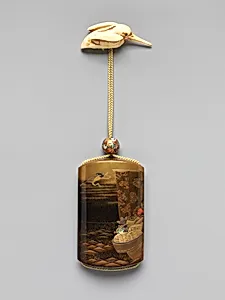
梶川文竜斎作 宝船蒔絵印籠|Inrō with Treasure Boat
19th century
Medium
Gold and black lacquer and nashiji ground with gold and silver hiramaki-e, red lacquer, and mother-of-pearl inlay Netsuke: kingfisher; carved ivory Ojime: Chinese children; porcelain (Kutani ware
Dimensions
3 7/16 x 2 1/16 x 13/16 in. (8.7 x 5.3 x 2 cm)
Classification
Inrō
Culture & Period
Japan · Edo period (1615–1868)
Department
Asian Art
Museum
Metropolitan Museum of Art, New York, NY
Credit
The Howard Mansfield Collection, Purchase, Rogers Fund, 1936
Accession Number
36.100.183
Rights
Public Domain
Tags
Art Historical Context
Step into the refined world of Edo-period Japan with this stunning *Inrō with Treasure Boat* by master lacquer artist Kajikawa Bunryūsai crafted in the 19th. An *inrō* was a portable, multi-tiered case used by samurai and merchants to carry medicines, seals, or tobacco—suspended from the sash (*obi*) via a cord secured by a *netsuke* toggle and *ojime* bead. This diminutive treasure, measuring just 3 7/16 x 2 1/16 x 13/16 inches, exemplifies the era's obsession with exquisite personal accessories amid Japan's peaceful prosperity (1615–1868). Bunryūsai's genius shines in the intricate *makie* techniques: a shimmering *nashiji* (pear-skin) ground of gold flecks under gold and black lacquer, adorned with flat *hiramaki-e* (sprinkled gold and silver powder) depicting an auspicious treasure ship laden with riches, cranes, and waves, plus red lacquer and iridescent mother-of-pearl inlay. The ensemble completes with a finely carved ivory *netsuke* of a kingfisher—symbolizing longevity and good fortune—and a playful *ojime* of Chinese children in vibrant Kutani porcelain. As part of The Howard Mansfield Collection at The Metropolitan Museum of Art, this piece highlights lacquerware's pinnacle as wearable art, blending functionality, symbolism, and technical virtuosity to evoke wishes for wealth and harmony in daily life.