
Insertion
Unknown Artist
16th century
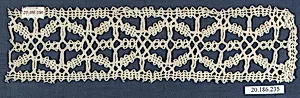
Medium
Bobbin lace
Dimensions
L. 8 1/2 x W. 2 inches 21.6 x 5.1 cm
Classification
Textiles-Laces
Culture
Italian, Venice
Department
European Sculpture and Decorative Arts
Museum
Metropolitan Museum of Art, New York, NY
Credit
Rogers Fund, 1920
Accession Number
20.186.235
Rights
Public Domain
Art Historical Context
Step into the intricate world of 16th Venetian lace with *Insertion*, a exquisite example of bobbin lace crafted in Italy's lagoon city, a renowned hub of lace production during the Renaissance. Measuring just 8½ by 2 inches (21.6 x 5.1 cm), this delicate strip was designed as an "insertion"—a narrow band meant to be seamlessly sewn between fabric edges in garments, linens, or ecclesiastical textiles, adding elegance and opulence. Bobbin lace, the medium here, exemplifies a masterful technique where threads are twisted and plaited using small bobbins, allowing for complex, geometric patterns that rival needle lace in precision. Venice's lacemakers drew from Flemish influences while innovating local styles, exporting their wares across Europe to adorn the collars, cuffs, and ruffs of nobility. Acquired through the Rogers Fund in 1920 and housed in the Metropolitan Museum of Art's European Sculpture and Decorative Arts department, this anonymous artwork highlights the anonymous skill of Venetian artisans, whose craft symbolized luxury and piety in an era of expanding trade and artistic refinement.