
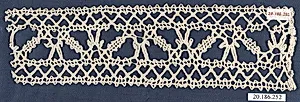
Insertion
Unknown Artist
17th century
Medium
Bobbin lace
Dimensions
L. 2 1/4 x W. 8 1/2 inches (5.7 x 21.6 cm)
Classification
Textiles-Laces
Culture
Italian, Venice
Department
European Sculpture and Decorative Arts
Museum
Metropolitan Museum of Art, New York, NY
Credit
Rogers Fund, 1920
Accession Number
20.186.252
Rights
Public Domain
Art Historical Context
Step into the opulent world of 17-century Venice with *Insertion*, a delicate strip of bobbin lace that exemplifies the city's mastery of textile arts. Crafted in Italy's lace-making capital, this narrow band—measuring just 2¼ x 8½ inches—was designed as an "insertion," a decorative element seamlessly woven into garments like collars, cuffs, or linens to add refined elegance. Acquired through the Rogers Fund in 1920, it now graces the Metropolitan Museum of Art's European Sculpture and Decorative Arts collection. Bobbin lace, the medium here, involved skilled artisans twisting and intertwining fine silk or linen threads using small bobbins—wooden spools that allowed for complex, geometric patterns. Venetian lacemakers, rivals to Flanders in technique, elevated this craft during the Baroque era, when lace became a symbol of wealth and sophistication among nobility and clergy. This piece's precise construction highlights the labor-intensive process, often taking weeks for such intricate designs. Culturally, Venetian lace fueled a booming export trade, adorning royal wardrobes across Europe and influencing fashion from the Renaissance onward. Though by an unknown artist, *Insertion* captures the anonymous genius of guild-trained women whose handiwork turned thread into wearable treasure, offering a tactile glimpse into a golden age of decorative splendor.