
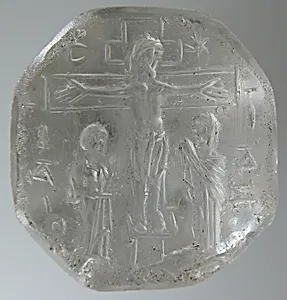
Intaglio Seal with the Crucifixion
Unknown Artist
9th–11th century
Medium
Rock crystal
Dimensions
Overall: 13/16 x 11/16 x 15/16 in. (2 x 1.8 x 2.4 cm)
Classification
Lapidary Work-Crystal
Culture
Byzantine
Department
Medieval Art
Museum
Metropolitan Museum of Art, New York, NY
Credit
Purchase, 1886
Accession Number
86.11.38
Rights
Public Domain
Tags
Art Historical Context
This exquisite intaglio seal, carved from rock crystal in the Byzantine Empire between the 9th and 11th centuries, captures the poignant scene of the Crucifixion featuring Christ on the Cross flanked by the Virgin Mary. Measuring just under an inch in each dimension, its diminutive size belies its intricate craftsmanship. Rock crystal, prized for its clarity and durability, was a favored medium for lapidary work—engravings incised into the stone to create a raised impression when stamped into wax or clay. Such seals served practical purposes like authenticating documents while doubling as devotional objects. In Byzantine culture, amid a flourishing of religious art following the end of Iconoclasm, this seal reflects deep Christian piety. The Crucifixion motif, central to Orthodox theology, symbolized redemption and was common in portable artifacts worn as amulets for protection. Its unknown artist exemplifies the skilled, anonymous workshops of Constantinople, where gem engraving blended technical precision with spiritual symbolism. Acquired by The Metropolitan Museum of Art in 1886, this rare survivor offers a window into medieval daily devotion, reminding us how faith was etched into everyday life.