
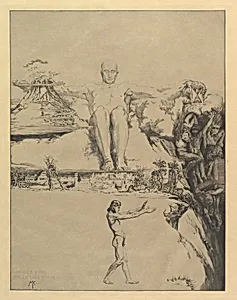
"Integer Vitae...", from the series Vom Tode Zweiter Teil
1878, later edition
Medium
Copper engraving
Dimensions
Plate: 15 15/16 × 12 1/2 in. (40.5 × 31.8 cm) Sheet: 24 1/16 × 18 1/8 in. (61.1 × 46 cm)
Classification
Prints
Department
Drawings and Prints
Museum
Metropolitan Museum of Art, New York, NY
Credit
Gift of Robert L. Isaacson, 1979
Accession Number
1979.674.5
Rights
Public Domain
Tags
Art Historical Context
Max Klinger’s “Integer Vitae…,” from the 1878 series *Vom Tode* (On Death), Part Two, invites viewers into a meditation on mortality and moral integrity. The Latin title, drawn from Horace’s famous ode, evokes the ideal of a blameless life—“integer vitae scelerisque purus”—setting the tone for a symbolic exploration of human existence. Rendered as a copper engraving, the print showcases Klinger’s masterful command of line and texture, allowing delicate gradations that heighten the dramatic contrast between the nude male figures and the stark mountain landscape. As part of a larger cycle examining death’s many faces, this work reflects the Symbolist movement’s interest in philosophical and psychological themes rather than literal narrative. Klinger’s precise engraving technique transforms the copper plate into a vehicle for both intimate detail and sweeping atmosphere, encouraging prolonged contemplation. Housed in the Metropolitan Museum of Art’s Department of Drawings and Prints, the sheet stands as a testament to late-nineteenth-century printmaking’s power to convey profound ideas about life’s journey and its inevitable end.
About the Artist
Max Klinger · 1857–1920
Max Klinger, born on February 18, 1857, in Leipzig to a wealthy family, emerged as one of Germany's most innovative artists across painting, sculpture, printmaking, and graphics. Demonstrating early talent, he enrolled at the Academy of Fine Arts in Karlsruhe in 1874 as a pupil of Karl Gussow, following his teacher to the Berlin Academy upon Gussow's appointment as director, and graduated in 1877 ...