Ctrl K
1857–1920
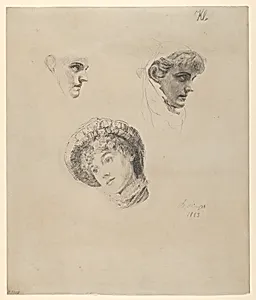
Max Klinger, born on February 18, 1857, in Leipzig to a wealthy family, emerged as one of Germany's most innovative artists across painting, sculpture, printmaking, and graphics. Demonstrating early talent, he enrolled at the Academy of Fine Arts in Karlsruhe in 1874 as a pupil of Karl Gussow, following his teacher to the Berlin Academy upon Gussow's appointment as director, and graduated in 1877 with exceptional honors. He honed his skills further through an apprenticeship in engraving under Hermann Sagert and brief studies in Brussels with Émile Wauters, immersing himself in the etchings of masters like Dürer, Rembrandt, Goya, and Menzel. Klinger's debut at the 1878 Berlin Academy exhibition with his *Paraphrase on the Finding of a Glove*—a series of ten dreamlike etchings triggered by a lost glove, blending fantasy and erotic symbolism—shocked audiences and established his reputation for bold originality.
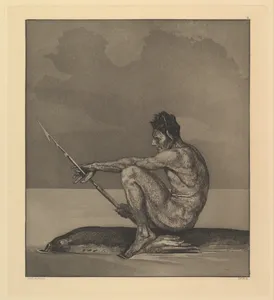
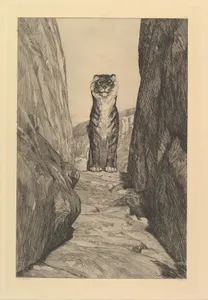
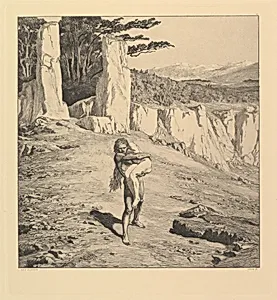
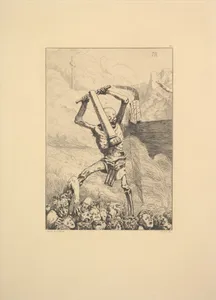
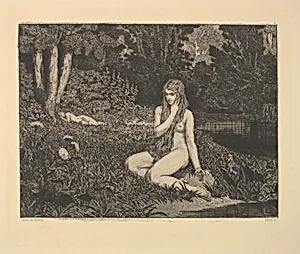
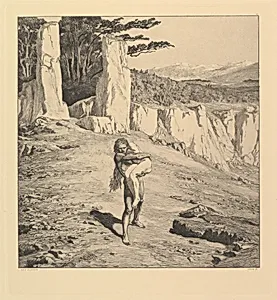
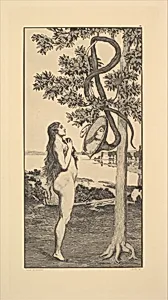
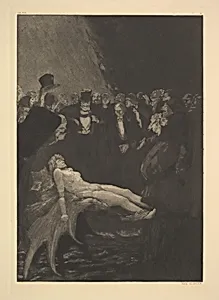
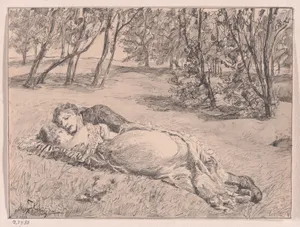
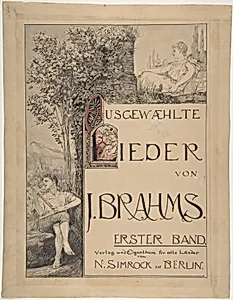
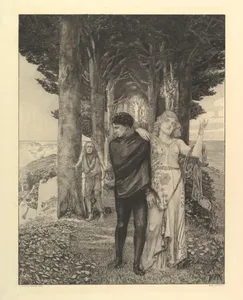
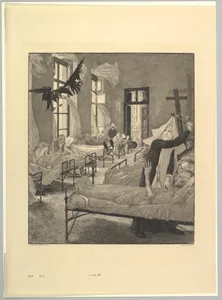
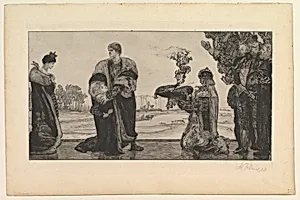
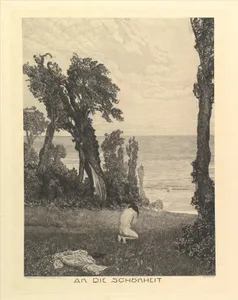
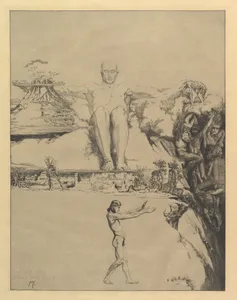
Klinger worked in the Symbolist tradition, infused with Jugendstil elegance and a penchant for the grotesque, morbid, and subconscious, reviving fine printmaking in Germany through intricate intaglio cycles that fused narrative, music, and poetry into Gesamtkunstwerke. Key print series include *A Life* (1884), chronicling a woman's descent into prostitution amid bourgeois hypocrisy; *Brahms Fantasie* (1894), a 41-plate homage to his friend Johannes Brahms; and *On Death* (Part I, 1889; Part II, 1898–1910), allegorical meditations on mortality. His paintings, such as the melancholic *The Blue Hour* (1890) and *Pietà* (1890), employed reduced palettes to evoke yearning and isolation, while sculptures like the multimedia *Beethoven* (1902)—crafted from bronze, ivory, and exotic marbles—and *Cassandra* (1895) showcased his anatomical precision and mythic grandeur. Travels to Italy and Paris deepened his engagement with antiquity, anatomy, and naturalism, influenced by Böcklin and Darwin.
In his 1891 treatise *Painting and Drawing*, Klinger championed graphic arts' independence from painting, advocating neo-idealism alongside realism. Associated with the Vienna Secession, he founded the Villa Romana prize, supporting artists like Käthe Kollwitz and Max Beckmann. His visionary cycles prefigured Surrealism and Expressionism, profoundly shaping Giorgio de Chirico, Max Ernst, Edvard Munch, and others, cementing his legacy as a bridge from Symbolism to modernism until his death on July 5, 1920, near Naumburg.