
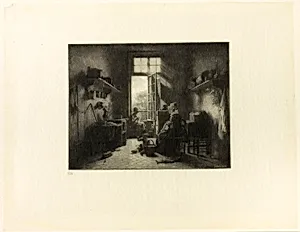
Interior of a Kitchen
1907, after the painting of 1817
Medium
Wood engraving on China paper
Dimensions
Image: 12.9 × 16.6 cm (5 1/8 × 6 9/16 in.); Sheet: 23.3 × 29.9 cm (9 3/16 × 11 13/16 in.)
Classification
wood engraving
Department
Prints and Drawings
Museum
Art Institute of Chicago
Accession Number
180724
Rights
Public Domain
Art Historical Context
Step into the cozy confines of *Interior of a Kitchen*, a wood engraving by Timothy Cole 1907. This print faithfully reproduces an intimate 1817 painting, the everyday textures of domestic life—perhaps pots, utensils, and worn surfaces that evoke early 19th-century hearths. Measuring a compact 12.9 × 16.6 cm, it's a testament to Cole's skill in translating oil painting's richness into black-and-white precision. Cole, a pioneering American woodaver (1852–1931), elevated the medium from mere illustration to fine art. Working on end-grain boxwood with fine burins, he achieved extraordinary detail rivaling photographs, often for publications like *Century Magazine*. Printed on thin, luxurious China paper, this impression enhances clarity and tonal subtlety, making the kitchen's shadows and highlights leap off the page—a nod to reproductive printmaking's role in democratizing art access. Housed in the Art Institute of Chicago's Prints and Drawings department, this work bridges eras: the humble realism of Regency-era interiors meets early 20th-century innovation. It reminds us how prints preserved fleeting glimpses of history, inviting modern viewers to savor the artistry in the ordinary.
About the Artist
Timothy Cole · 1852–1931
Timothy Cole (1852–1931) was one of the most celebrated wood engravers of the nineteenth and early twentieth centuries, renowned for his extraordinary ability to translate the tonal richness of Old Master paintings into the exacting medium of engraved wood. Born in London, England, Cole emigrated with his family to the United States in 1858. He began his career as a wood engraver in Chicago, but t...