
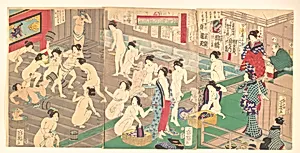
Interior of a Public Bath
19th century
Medium
Triptych of woodblock prints; ink and color on paper
Dimensions
Image (a): 14 1/4 x 9 3/4 in. (36.2 x 24.8 cm) Image (b): 14 1/2 x 9 1/2 in. (36.8 x 24.1 cm) Image (c): 14 1/4 x 9 7/8 in. (36.2 x 25.1 cm)
Classification
Prints
Culture & Period
Japan · Edo period (1615–1868)
Department
Asian Art
Museum
Metropolitan Museum of Art, New York, NY
Credit
Bequest of William S. Lieberman, 2005
Accession Number
2007.49.320a–c
Rights
Public Domain
Tags
Art Historical Context
Step into the steamy world of 19th-century Japan with Utagawa Yoshiiku's *Interior of a Public Bath*, captivating triptych woodblock from the Edo period (1615–1868). Yoshiiku, a master of ukiyo-e tradition—meaning "pictures of the floating world"—excelled in depicting everyday pleasures and urban life. This vibrant work, composed of three panels in ink and color on paper (each roughly 14 x 9 inches), unfolds a panoramic scene of a communal sento, or public bathhouse, where, women, and children mingle freely in a ritual of cleansing and socializing. In Edo-era Japan, bathhouses were vital social hubs, normalizing nudity across genders and ages in a culture that viewed bathing as both practical and communal. Yoshiiku's print captures this intimacy with bold lines, vivid colors, and dynamic compositions typical of woodblock printing, where intricate carvings on wooden blocks allowed mass production for affordable enjoyment by the masses. Female nudes, men, and playful children fill the frame, highlighting the unselfconscious joy of the era's bathing customs before modern separations. Housed in the Metropolitan Museum of Art's Asian Art Department, this bequest from William S. Lieberman preserves a slice of vanishing daily life, reminding us how ukiyo-e artists like Yoshiiku immortalized the ephemeral vibrancy of old Tokyo.
About the Artist
Utagawa Yoshiiku · 1833–1904
Utagawa Yoshiiku (1833–1904) was a prolific Japanese woodblock print artist and journalist who lived through one of the most turbulent and transformative periods in his country's history, the transition from the Edo period through the Meiji Restoration. A student of the celebrated Utagawa Kuniyoshi, Yoshiiku inherited his master's taste for bold compositional drama and dynamic figuration, applying...