
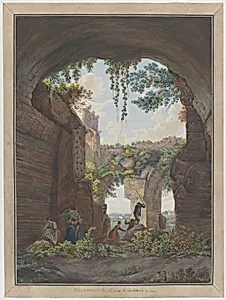
Interior of the Baths at Caracalla
Medium
Etching, with watercolor and gouache
Dimensions
Mat: 31 1/8 × 23 1/4 in. (79 × 59 cm) Image: 28 1/8 × 20 9/16 in. (71.5 × 52.2 cm)
Classification
Prints
Department
Drawings and Prints
Museum
Metropolitan Museum of Art, New York, NY
Credit
Gift of Mrs. Charles Wrightsman, 2009
Accession Number
2009.383
Rights
Public Domain
Tags
Art Historical Context
Step into the majestic ruins of the Baths of Caralla through this captivating etching by Abraham Louis Rodolpheros and Giovanni Volp, created around 1780. Ducros, a Swiss artist renowned for his detailed vedute (topographical views) of ancient Roman sites, collaborated with the Italian engraver Volp to produce this vivid print. It captures the vast interior of the Baths, one of Rome's most impressive ancient complexes, built by Emperor Caracalla the early 3rd century AD as a symbol of imperial grandeur and public luxury. The artwork's etching technique allows for intricate lines that faithfully reproduce the soaring arches, massive brick vaults, and fragmented mosaics of the ruins, while delicate watercolor and gouache enhance the scene with lifelike color and depth. Figures of men and women—perhaps workers or visitors—animate the space, blending modern life with antiquity and evoking the era's fascination with classical heritage during the Grand Tour period, when European travelers flocked to Italy for inspiration. This print, now in the Metropolitan Museum of Art's Drawings and Prints collection, exemplifies 18th-century neoclassical interest in Roman engineering and evokes the baths' original splendor, where thousands once bathed amid opulent pools and gardens. A window into lost imperial glory!
About the Artist
Abraham Louis Rodolphe Ducros|Giovanni Volpato · 1748–1810
Abraham Louis Rodolphe Ducros, born on July 21, 1748, in Moudon, Switzerland, was the son of Jean-Rodolphe Du Cros, a writing and drawing master who taught at Yverdon College after the family relocated there. Destined initially for commerce following his father's death in 1764, Ducros pursued art passionately. He trained for two years (1769–1771) under Chevalier Nicolas-Henri-Joseph de Fassin at a...