
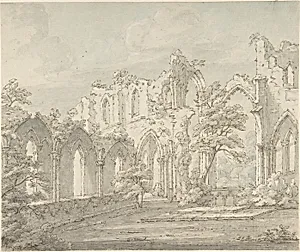
Interior view of Fountains Abbey, Yorkshire
mid-18th–early 19th century
Medium
Pen and ink, brush and blue and gray wash
Dimensions
Sheet: 9 5/8 x 11 1/2 in. (24.4 x 29.2 cm)
Classification
Drawings
Department
Drawings and Prints
Museum
Metropolitan Museum of Art, New York, NY
Credit
Harris Brisbane Dick Fund, 1930
Accession Number
30.49.5
Rights
Public Domain
Tags
Art Historical Context
Step into the evocative ruins of Fountains Abbey through this delicate drawing, capturing an interior view of one of England's most magnificent Cistercian monasteries in Yorkshire. Created in the mid-18th to 19th century and attributed to Alexander Cozens Thomas Sunderland—both pioneers in British landscape art—this work reflects the era's fascination with Gothic ruins. Fountains Abbey, founded in 1132 and dissolved by Henry VIII in 153, stands as a poignant symbol of medieval monastic life and its turbulent end, drawing artists to its soaring arches and weathered stone. Rendered in pen and ink with subtle blue and gray washes on a modest 9⅝ × 11½-inch sheet, the piece masterfully employs wash techniques to evoke atmospheric depth and the play of light through decayed vaults. Cozens, known for innovative ink-blot methods inspiring organic forms, and Sunderland, a specialist in luminous ruinscapes, highlight the sublime beauty in decay—a Romantic ideal celebrating nature's reclamation of human ambition. Housed in the Metropolitan Museum of Art's Drawings and Prints department (Harris Brisbane Dick Fund, 1930), this intimate study invites visitors to ponder the passage of time, blending topographical precision with emotional resonance. A window into 18th-century artistic exploration of Britain's heritage.
About the Artist
Alexander Cozens|Thomas Sunderland · 1717–1786
Alexander Cozens (1717–1786) was a pioneering British landscape painter in watercolours, born in Saint Petersburg, Russia, to English shipbuilder Richard Cozens, who served Peter the Great—the tsar even stood as Alexander's godfather. Educated in England from age ten, he returned to Russia before embarking on a formative journey in 1746, sailing to Italy where he worked in the studio of the esteem...