Ctrl K
1717–1786
Alexander Cozens (1717–1786) was a pioneering British landscape painter in watercolours, born in Saint Petersburg, Russia, to English shipbuilder Richard Cozens, who served Peter the Great—the tsar even stood as Alexander's godfather. Educated in England from age ten, he returned to Russia before embarking on a formative journey in 1746, sailing to Italy where he worked in the studio of the esteemed French landscape painter Claude-Joseph Vernet in Rome. This classical training honed his skills in elegant composition and dramatic light effects, evident in his early Italian drawings now held in the British Museum. Settling in England around 1748, Cozens married Charlotte Pine, daughter of engraver John Pine, and established himself as a drawing master at Christ's Hospital (1750–1754) and Eton College (1763–1768), tutoring luminaries like the future George III, Sir George Beaumont, and William Beckford.
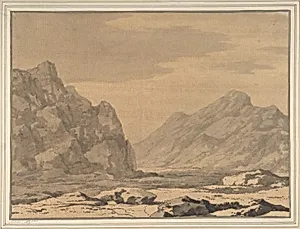
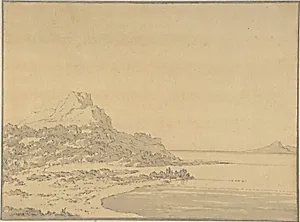
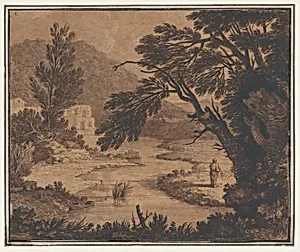
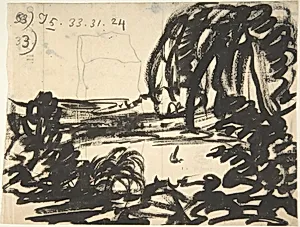
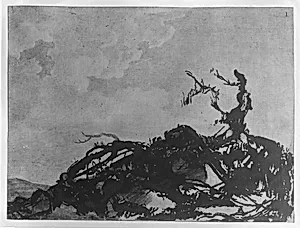
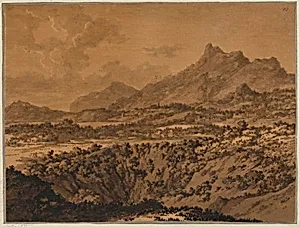
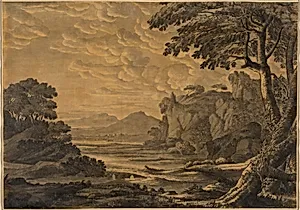
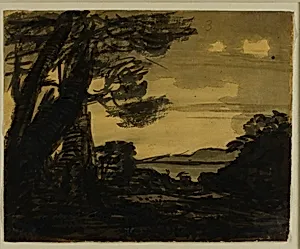
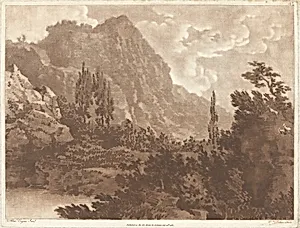
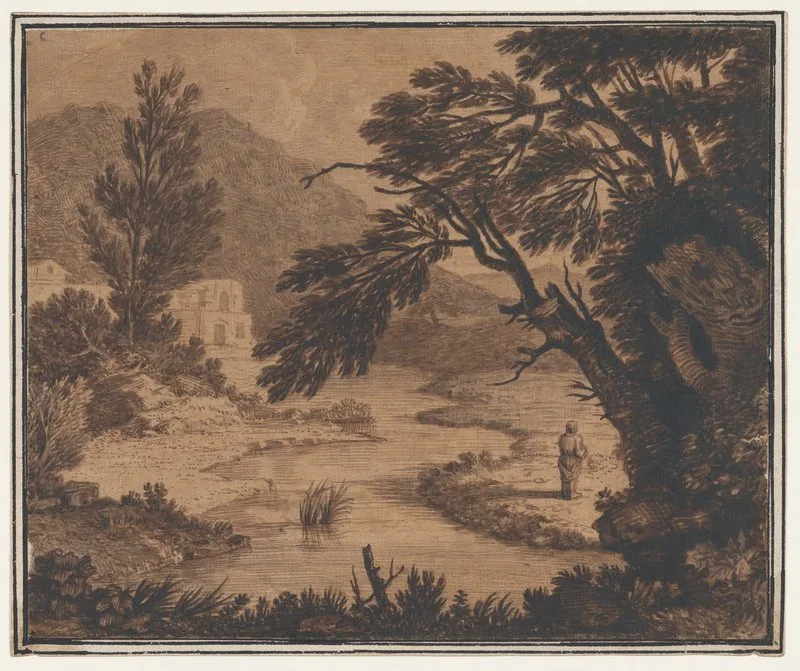
Cozens championed the idealizing school of landscape art, emphasizing poetic imagination over mere topography, and became renowned as the "Blotmaster" for his revolutionary "blot" technique—inspired by Leonardo da Vinci—where accidental ink smudges were coaxed into romantic vistas of mountains, waterfalls, and clouds. He codified this in his 1785 treatise *A New Method of Assisting the Invention in Drawing Original Compositions of Landscape*, alongside earlier works like *Principles of Beauty Relative to the Human Head* (1778) and tree studies (1771). His monochromatic watercolours prioritized massed forms, intense chiaroscuro, and sublime atmospheric drama, as seen in *Vale near Matlock*, *Setting Sun* (oils, c.1770–1773), and *A Blot-Lake with Boat, Surrounded by Trees* (c.1750–1786, Metropolitan Museum).
Exhibiting from 1760 at the Society of Arts, Free Society, Incorporated Society of Artists, and Royal Academy (1772–1781), Cozens elevated landscape's intellectual status. Father to acclaimed watercolourist John Robert Cozens, he profoundly influenced Joseph Wright of Derby and later generations, reviving interest in imaginative invention during the 20th-century watercolor renaissance. Though eclipsed by his son in the 19th century, Cozens's blots prefigured modern abstraction, proving chance could birth enduring beauty.