
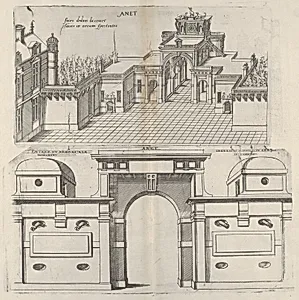
Interior View of the Court Yard and Frontal View of the Defense Mechanism at Chateau d'Anet
Medium
Engraving
Dimensions
sheet: 15 3/4 x 19 11/16 in. (40 x 50 cm) image: 5 9/16 x 10 1/8 in. (14.2 x 25.7 cm) image: 6 1/16 x 11 7/16 in. (15.4 x 29 cm)
Classification
Prints|Ornament & Architecture
Department
Drawings and Prints
Museum
Metropolitan Museum of Art, New York, NY
Credit
Bequest of Phyllis Massar, 2011
Accession Number
2012.136.167.3
Rights
Public Domain
Tags
About this artwork
This engraving presents interior and frontal views of the courtyard and defensive mechanisms at Château d'Anet, published in 1607 from designs by Jacques Androuet du Cerceau. The print documents one of France's notable Renaissance buildings, demonstrating du Cerceau's systematic approach to architectural documentation through measured drawings that combine plan, elevation, and perspective views. The engraving shows the architectural details and spatial organization of the château with the precis...
Art Historical Context
This enchanting engraving by Jacques Androuet duceau captures the grandeur of Château d'Anet's courtyard and its defensive mechanisms, offering both interior and frontal views. Published posthumously in 1607—long after the artist's death in 1584 exemplifies du Cerceau's mastery as a French Renaissance architect and printmaker. precise measured drawings that blend plan, elevation, and perspective, print meticulously documents architectural details and spatial harmony, making it a treasured resource for 16th- and 17th-century builders and patrons. Château d'Anet, constructed for Diane de Poitiers, the influential mistress of King Henry II, embodies French Renaissance ideals: elegant proportions adapted from Italian models to suit local tastes, complete with sophisticated fortifications. Du Cerceau immortalized such jewels in his seminal work *Les plus excellents bastiments de France* (1576–1579), a two-volume series of engravings that preserved visuals of now-altered or lost structures. This 1607 edition, drawn from his enduring plates, continued his legacy. As a medium, engraving allowed widespread dissemination of these designs across Europe, inspiring classical architecture and celebrating France's cultural prowess. Visitors today can appreciate how du Cerceau's technical precision not only served practical emulation but also elevated architecture as high art. (198 words)
About the Artist
Jacques Androuet Du Cerceau · 1510–1585
Jacques I Androuet du Cerceau (c. 1510–1584), born in Paris to a wine merchant, emerged as a pivotal figure in introducing Renaissance architecture to France through his innovative designs and engravings. Trained as an architect, decorator, and engraver, he established a printshop in Orléans around 1549, where he began producing influential suites of engravings, starting with triumphal arches. His...