
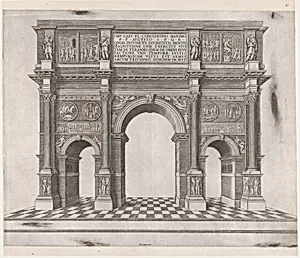
Speculum Romanae Magnificentiae: Arch of Constantine
16th century
Medium
Engraving and etching
Dimensions
sheet: 13 1/2 x 16 3/4 in. (34.3 x 42.5 cm) mount: 14 5/8 x 16 3/4 in. (37.1 x 42.5 cm)
Classification
Prints
Department
Drawings and Prints
Museum
Metropolitan Museum of Art, New York, NY
Credit
Harris Brisbane Dick Fund, 1941
Accession Number
41.72(1.81)
Rights
Public Domain
Tags
About this artwork
Speculum Romanae Magnificentiae: Arch of Constantine by Antonio Lafreri|Anonymous|Antonio Lafreri, 16th century. Created in Engraving and etching, this work exemplifies the artistic practices and cultural values of its period. The piece reflects the technical skills and aesthetic sensibilities characteristic of its historical and cultural context. As part of the Drawings and Prints collection, it contributes to our understanding of artistic development and cultural expression. The work serves as...
Art Historical Context
This 16th-century engraving and etching, titled *Speculum Romanae Magnificentiae: Arch of Constantine*, belongs to a renowned series of prints documenting Rome’s ancient monuments. Compiled and published by Antonio Lafreri, the *Speculum* (or “Mirror of Roman Magnificence”) captured the enduring fascination with classical antiquity during the Renaissance, when scholars, artists, and travelers sought to study and preserve the city’s architectural heritage through widely circulated images. Created through the precise techniques of engraving and etching, the work highlights the period’s advancements in printmaking. These methods allowed intricate details of arches, sculptures, and inscriptions to be reproduced with remarkable clarity, transforming the Arch of Constantine into both an aesthetic object and an educational document. Visitors to the virtual collection can appreciate how such prints helped disseminate knowledge of Roman engineering and imperial history across Europe. Housed in the Metropolitan Museum of Art’s Department of Drawings and Prints, this sheet exemplifies the cultural value placed on Rome’s ruins as symbols of grandeur and continuity. Its measured depiction invites viewers to explore the Arch’s historical layers while reflecting on the Renaissance desire to bridge past and present through art.
About the Artist
Antonio Lafreri|Anonymous|Antonio Lafreri · 1507–1577
Antonio Lafreri, born Antoine du Pérac Lafréry around 1512 in Orgelet in the County of Burgundy (modern-day France), emerged as one of the most influential print publishers of the 16th century after settling in Rome around 1540. His early life and training remain sparsely documented, with no records of specific teachers or art schools; he arrived in the Eternal City as an engraver, producing works...