
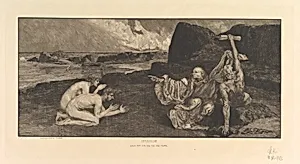
Intermezzo (from the series A Love)
1887–1903
Medium
Etching and engraving; third state; state eight of ten
Dimensions
Plate: 9 5/8 × 18 1/16 in. (24.5 × 45.8 cm) Sheet: 16 1/16 × 21 7/8 in. (40.8 × 55.6 cm)
Classification
Prints
Department
Drawings and Prints
Museum
Metropolitan Museum of Art, New York, NY
Credit
Gift of Dr. F. H. Hirschland, 1952
Accession Number
52.586.1(6)
Rights
Public Domain
Tags
Art Historical Context
Max Klinger’s *Intermezzo* belongs to his celebrated print cycle *A Love* (Eine Liebe), a series of ten etchings and engravings that traces the emotional arc of romantic passion. Created between 1887 and 1903, the work reflects the Symbolist movement’s interest in inner experience, desire, and the psychological dimensions of love. Klinger, a German artist renowned for his technically ambitious printmaking, used the medium to blend realistic detail with dreamlike narrative, inviting viewers to contemplate both the tenderness and tension inherent in human relationships. The plate’s refined etching and engraving technique—here in its eighth state—allowed Klinger to achieve delicate tonal gradations and crisp linear definition, especially effective for rendering the male nude forms noted in the work. These figures underscore the series’ frank exploration of the body as both subject and symbol. Printed by Wilhelm Felsing, the impression now in the Metropolitan Museum’s collection exemplifies the high craftsmanship of late-nineteenth-century reproductive printmaking. Acquired as a gift in 1952, *Intermezzo* offers today’s visitors an intimate glimpse into Klinger’s vision of love as a profound, often ambivalent human drama.
About the Artist
Wilhelm Felsing|Max Klinger (German| ) · 1857 | –1920 |
German, Leipzig 1857–1920 Großjena|