
Intérieur (Les brodeuses)
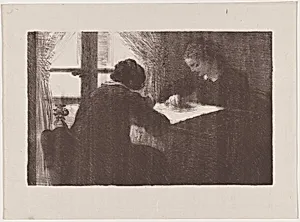
Medium
lithograph in brown-violet on china paper
Classification
Portfolio
Department
CG-E
Museum
National Gallery of Art, Washington, D.C.
Credit
Virginia and Ira Jackson Collection, gift in memory of Virginia H. Jackson
Accession Number
1996.151.197
Rights
Public Domain
Art Historical Context
Henri Fantin-Latour's *Intérieur (Les brouses)*, created in 1895, captures a serene moment of domestic tranquility in late 19th-century France The French artist, renowned for his meticulous Realism and subtle Symbolist influences, often depicted intimate interiors and still lifes with a quiet poetry. Here, women engrossed in embroidery evoke the era's fascination with everyday rituals, highlighting the grace and patience of feminine pursuits amid the fin-de-siècle cultural shift toward introspection. Printed as a lithograph in warm brown-violet tones on delicate china paper, the work showcases Fantin-Latour's mastery of printmaking. Lithography allowed him to achieve soft, velvety textures and nuanced shading, with the thin china paper enhancing the ink's richness and intimacy—ideal for subtle, monochromatic scenes. As part of a portfolio (Department CG-E), it reflects the growing accessibility of fine art through prints during the 1890s. Now in the National Gallery of Art, thanks to the Virginia and Ira Jackson Collection (gift in memory of Virginia H. Jackson), this piece invites visitors to savor Fantin-Latour's elegant restraint, bridging Realism's precision with the era's emotional depth. A testament to quiet beauty in a changing world.
About the Artist
Henri Fantin-Latour · 1836–1904
Ignace Henri Jean Théodore Fantin-Latour was born on January 14, 1836, in Grenoble, France, to portrait painter Théodore Fantin-Latour, who gave him his earliest drawing lessons. The family relocated to Paris in 1841, where in 1850, at age 14, he enrolled in the École de Dessin, studying under Horace Lecoq de Boisbaudran, whose innovative memory-based method of drawing from observation profoundly ...