
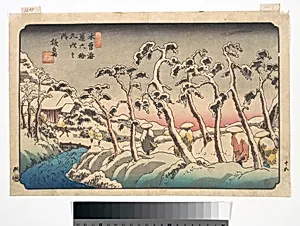
Itabana Station
late 1830s
Medium
Woodblock print; ink and color on paper
Dimensions
Oban 9 5/8 x 14 7/16 in. (24.4 x 36.7 cm)
Classification
Prints
Culture & Period
Japan · Edo period (1615–1868)
Department
Asian Art
Museum
Metropolitan Museum of Art, New York, NY
Credit
Rogers Fund, 1919
Accession Number
JP1201
Rights
Public Domain
Tags
Art Historical Context
Keisai Eisen’s “Itabana Station,” created in the late 1830s during Japan’s Edo period, captures a tranquil winter moment at one of the post stations along a major travel route. As an ukiyo-e woodblock print rendered in ink and color on paper, it exemplifies the accessible yet refined art form that flourished among townspeople and travelers alike. Eisen, celebrated for both his portraits of beautiful women and atmospheric landscapes, here turns his attention to the quiet rhythms of rural life under snow. The scene’s delicate balance of bare trees, falling snow, and small human figures conveys the chill and stillness of a mountain station stop. Woodblock printing allowed such images to be reproduced in large editions, making distant places vivid for audiences in bustling Edo. Measuring roughly the standard oban size, the print’s horizontal format invites viewers to linger over the subtle gradations of color and the way snow softens the landscape. Today housed in the Metropolitan Museum of Art, “Itabana Station” offers a window into nineteenth-century Japanese travel culture and the poetic sensibility of ukiyo-e artists who found beauty in fleeting seasonal moments.
About the Artist
Keisai Eisen · 1790–1848
Keisai Eisen (1790–1848), born Ikeda Yoshinobu in Edo (modern Tokyo), emerged as one of the late Edo period's most prolific ukiyo-e masters. The son of the renowned calligrapher and Kanō-school painter Ikeda Shigeharu, Eisen was immersed in the arts from childhood. He apprenticed under Kanō Hakkeisai, adopting the art name "Keisai" in homage to his teacher, and later studied bijin-ga (images of be...