
IV. A Menilmontant de Bruant
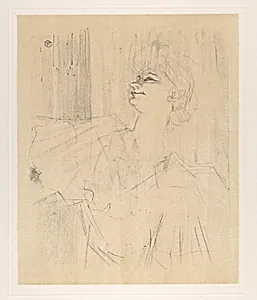
Medium
Lithograph printed with beige tint stone on laid paper
Dimensions
19-3/4 x 14-7/8 in. (50.2 x 37.8 cm)
Classification
Prints
Department
Drawings and Prints
Museum
Metropolitan Museum of Art, New York, NY
Credit
Gift of Mrs. H. Wolf, 1917
Accession Number
17.52.6
Rights
Public Domain
Tags
Art Historical Context
Henri de Toulouse-Lautrec's *IV. À Menilmontant de Bruant* (1898) is a captivating lithograph printed with a beige tint stone on laid paper, measuring 19-3/4 x 14-7/8 inches. This print, now housed in the Metropolitan Museum of Art's Drawings and Prints department (gift of Mrs. H. Wolf, 1917), exemplifies the artist's mastery of lithography during Paris's Belle Époque. Toulouse-Lautrec, a Post-Impressionist innovator, revolutionized printmaking by blending fine art with bold advertising posters, often capturing the gritty glamour of Montmartre's cabaret scene. The title references Aristide Bruant, the bohemian chansonnier whose raw, working-class songs like "À Menilmontant" celebrated Parisian underbelly life. As the fourth in a series, this work likely evokes Bruant's performances at venues like Le Mirliton, with its tag "Women" hinting at the female figures—perhaps prostitutes or dancers—that populated Lautrec's world. His flattened forms, vibrant lines, and psychological insight brought street vitality to paper, making art accessible beyond elite salons. Lautrec's tinted lithography technique added subtle warmth and texture, bridging commercial posters and collector's prints. This piece reflects fin-de-siècle cultural shifts, immortalizing the era's fascination with urban nightlife and social outsiders, inviting visitors to glimpse 1890s Paris's electric pulse.
About the Artist
Henri de Toulouse-Lautrec · 1864–1901
Henri Marie Raymond de Toulouse-Lautrec-Montfa (1864-1901) was a French Post-Impressionist painter, printmaker, and illustrator whose innovative poster designs revolutionized graphic art and advertising in late 19th-century Paris. Born into an aristocratic family at Albi in southern France, Toulouse-Lautrec's privileged lineage traced back to the Counts of Toulouse and extended uninterrupted to th...