
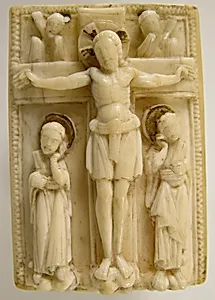
Ivory Plaque with the Crucifixion
Unknown Artist
ca. 1000
Medium
Ivory with gilding
Dimensions
1 5/8 x 1 1/8 x 3/8 in. (4.1 x 2.8 x 0.9 cm)
Classification
Ivories
Culture
Ottonian
Department
Medieval Art
Museum
Metropolitan Museum of Art, New York, NY
Credit
Gift of J. Pierpont Morgan, 1917
Accession Number
17.190.495a
Rights
Public Domain
Tags
Art Historical Context
This delicate ivory plaque, carved around 1000 AD during the Ottonian period, captures the poignant Crucifixion scene central to Christian devotion. Christ is depicted on the cross, flanked by the Virgin Mary and saints, figures rendered in high relief with expressive faces and flowing drapery. Measuring just 1⅝ × 1⅛ inches, its petite scale suggests it once adorned a portable devotional object, such as a book cover, diptych, or reliquary—common in medieval ecclesiastical art. Ottonian art, named for the Holy Roman Emperors Otto I, II, and III, marked a renaissance in northern Europe, blending Carolingian traditions with Byzantine influences. Ivory, prized for its creamy luster and carvability, was a luxury medium sourced from elephant tusks via trade routes. The addition of gilding—thin gold leaf applied to enhance halos and highlights—elevates its spiritual radiance, symbolizing divine light amid suffering. As a testament to 10th-century piety and craftsmanship, this anonymous masterpiece reflects how small-scale ivories served as intimate aids for prayer. Acquired through the generosity of J. Pierpont Morgan in 1917, it now graces The Metropolitan Museum of Art's Medieval collection, inviting us to ponder the enduring power of faith in miniature form.