
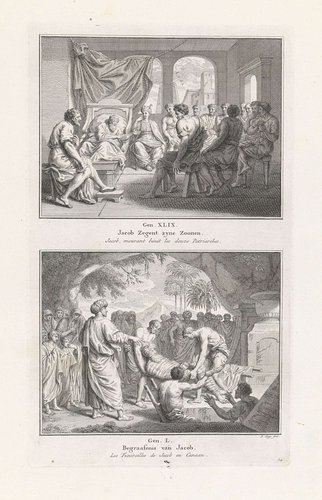
Jacob Zegent zyne Zoonen (...)/ Begraafenis van Jacob (...)
1791
Medium
etching
Dimensions
193; 327
Rights
Public Domain
About this artwork
Prent mogelijk gebruikt in: Hamelsveld, Ysbrand van. De gewigtigste geschiedenissen des Bybels, afgebeeld in twee honderd twee en vijftig printverbeeldingen (...) met eene zaaklijke uitbreiding opgehelderd. Amsterdam: Jan de Groot, Gerrit Warnars, Petrus van Hengst, Dordrecht: Abraham Blussé, Pieter Blussé, Leiden: Samuel Luchtmans (III), Johannes Luchtmans, Harlingen: Volkert van der Plaats, 1791.
Art Historical Context
Behold *Jacob Zegent zyne Zoonen (...)/ Begafnis van Jacob (...)*, a poignant etching by Dutch artist Pieter Tanjé, created in 1791. This work captures two pivotal moments from the Book of Genesis: the aged patriarch Jacob bestowing blessings upon his twelve sons, foreshadowing the future tribes of Israel, and his solemn burial, marking the end of an era. Measuring 327 mm high by 193 mm wide, the print's intimate scale invites close contemplation of familial legacy and mortality—themes central to biblical narratives. As an etching, Tanjé's technique excels in fine lines and tonal depth, ideal for reproducing intricate details in printed books. This piece likely served as one of 252 illustrations in Ysbrand van Hamelsveld's *De gewigtigste geschiedenissen des Bybels*, a comprehensive Dutch Bible history published that same year across Amsterdam, Dordrecht, Leiden, and Harlingen. Such volumes were vital educational tools in the late Enlightenment era, making sacred stories accessible to Protestant families through vivid imagery. Tanjé, a master engraver, contributed to the rich tradition of religious printmaking in the Netherlands, blending narrative drama with moral instruction. For visitors, this etching offers a window into 18th-century devotion, where art illuminated scripture for everyday life.
About the Artist
Pieter Tanjé · 1706–1761
**Pieter Tanjé (1706–1761)** was a Dutch reproductive engraver active in the eighteenth century. Born in Bolsward, he initially worked as a shipmate on the shipping service between his hometown and Amsterdam. In his spare time, he engraved designs for snuff boxes, an activity that proved so successful that it led to his artistic training. Encouraged by Jacob Folkema, Tanjé enrolled at the age of ...