
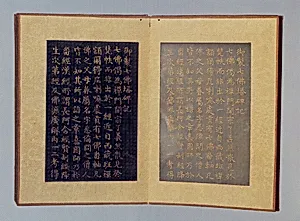
清中期 《御製七佛塔碑記》玉冊|Jade book
Unknown Artist
18th century
Medium
Jade (nephrite)
Dimensions
H. 5 9/16 in. (14.1 cm); W. 3 3/4 in. (9.5 cm); L. 1 9/16 in. (4 cm)
Classification
Jade
Culture & Period
China · Qing dynasty (1644–1911)
Department
Asian Art
Museum
Metropolitan Museum of Art, New York, NY
Credit
Gift of Heber R. Bishop, 1902
Accession Number
02.18.527
Rights
Public Domain
Art Historical Context
This exquisite jade book, titled *Imperial Composition: Record of the Buddha Pagoda Stele from the mid-Qing dynasty (18 century), exemplifies the pinnacle of imperial craftsmanship in China. Carved from nephrite jade—a material revered for its luminous translucence and symbolic purity—this compact artifact measures just 5 9/16 inches high, making it a precious, portable treasure likely intended for the emperor's personal library or ritual use. The intricately incised text records a stele inscription honoring the Seven Buddhas, blending Confucian scholarship with Buddhist devotion, a hallmark of Qing imperial culture. Crafted during the prosperous Qianlong era (1735–1796), when jade carving reached new heights of technical virtuosity, the book showcases masterful intaglio engraving. Artisans delicately chiseled the flowing calligraphy into the stone's surface, preserving the text's legibility while highlighting the jade's natural milky green hue. Such imperial commissions (denoted by *yuzhi*, or "imperially composed") underscore the emperor's role as a cultured patron, commissioning works that glorified Buddhist monuments and dynastic legacy. Today, this rare jade book, a gift to the Metropolitan Museum of Art in 1902, offers visitors a window into Qing opulence. Its survival speaks to the enduring cultural value of jade as a medium bridging the earthly and divine, where every curve and character tells a story of piety and power.