
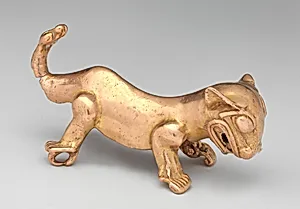
Jaguar Pendant
Unknown Artist
11th–16th century
Medium
Gold
Dimensions
H. 1 5/8 × W. 1 1/2 × D. 3 1/4 in. (4.1 × 3.8 × 8.3 cm)
Classification
Metal-Ornaments
Culture
Chiriquí
Department
Arts of Africa, Oceania, and the Americas
Museum
Metropolitan Museum of Art, New York, NY
Credit
Jan Mitchell and Sons Collection, Gift of Jan Mitchell, 1991
Accession Number
1991.419.6
Rights
Public Domain
Tags
Art Historical Context
This exquisite Jaguar Pendant, crafted by an unknown artist of the Chiriquí culture western Panama between the 11th and 16th centuries, exemplifies region's masterful pre-Columbian goldworking. Measuring just 1 5/8 × 1 1/2 × 3 1/4 inches, this small yet dynamic ornament depicts a snarling jaguar, its form captured in shimmering gold through intricate lost-wax casting—a technique that allowed artisans to create hollow, detailed figures from molds. Now housed in the Metropolitan Museum of Art's Department of Arts of Africa, Oceania, and the Americas (gift of Jan Mitchell, 1991), it invites visitors to marvel at its lifelike ferocity. In Chiriquí society, gold ornaments like this pendant were prestige items, likely worn by elites during rituals or as symbols of status. The jaguar, a powerful motif across Mesoamerican and Isthmian cultures, embodied strength, shamanic power, and the natural world's ferocity—often linking the wearer to supernatural forces or warrior prowess. These pieces highlight the Chiriquí people's advanced metallurgy, sourcing gold from local rivers and trading networks, and their skill in transforming raw metal into sacred jewelry that bridged the human and divine. Today, the pendant offers a window into a vibrant indigenous world just before European contact, reminding us of the artistry and spiritual depth of Panama's ancient peoples.