
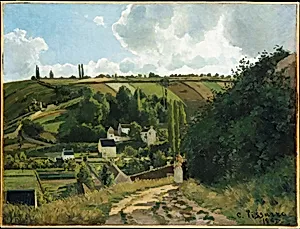
Jalais Hill, Pontoise
1867
Medium
Oil on canvas
Dimensions
34 1/4 x 45 1/4 in. (87 x 114.9 cm)
Classification
Paintings
Department
European Paintings
Museum
Metropolitan Museum of Art, New York, NY
Credit
Bequest of William Church Osborn, 1951
Accession Number
51.30.2
Tags
About this artwork
This expansive landscape captures the rural environs of Pontoise, a town just northwest of Paris that would become central to the development of Impressionism. Painted in 1867, before Pissarro fully embraced the Impressionist style, the work demonstrates his early commitment to plein-air painting and the truthful representation of rural French life. When exhibited at the Salon of 1868 alongside another rustic scene, the influential critic Émile Zola praised Pissarro's work enthusiastically, desc...
Art Historical Context
Camille Pissarro'sJalais Hill, Pontoise* (1867), an oil on canvas measuring ¼ × 45¼ inches, vividly captures the rolling rural landscapes and farms of Pontoise a town northwest of Paris that became a cradle for Impressionism. Painted before Pissarro fully embraced the, this expansive work showcases his pioneering plein-air approach—painting outdoors to truthfully depict everyday French countryside life, with its subtle atmospheric effects and shifting light across the hillside. Exhibited at the Salon of1868, the painting earned high praise from critic Émile Zola, who hailed it as embodying "t...
About the Artist
Camille Pissarro · 1831–1903
Camille Pissarro (1830-1903) stands as the patriarch of Impressionism, the only artist to exhibit in all eight Impressionist exhibitions and a mentor whose influence shaped the trajectory of modern art. Born Jacob Abraham Camille Pissarro on the Caribbean island of St. Thomas to a Jewish-Portuguese merchant family, he abandoned the family business to pursue painting, eventually settling in Paris i...